
Subcommittee Ranking Member McBath’s Opening Statement at Subcommittee Hearing on Republicans’ Selective Concern About Fraud
Washington, D.C. (January 21, 2026)—Today, Rep. Lucy McBath, Ranking Member of the Subcommittee on Crime and Federal Government Surveillance, delivered opening remarks at a subcommittee hearing on Republicans’ selective concern about fraud, while they stay silent as Trump pardons fraudsters, guts oversight and enriches himself from the Oval Office—harming all Americans.
Below are Ranking Member McBath’s remarks, as prepared for delivery, at today’s hearing.
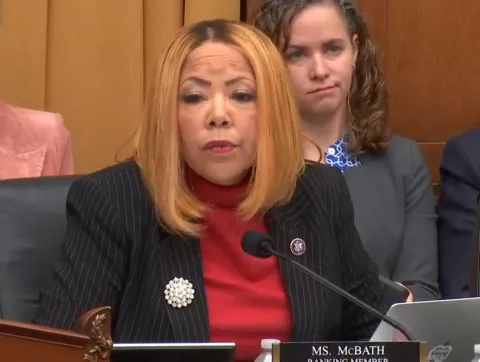
WATCH Ranking Member McBath’s opening statement.
Ranking Member Lucy McBath
Subcommittee on Crime and Federal Government Surveillance
“When Public Funds Are Abused: Addressing Fraud and the Theft of Taxpayer Dollars”
January 21, 2026
Thank you, Mr. Chair, for convening this hearing to talk about the harm that fraud can cause. It is so necessary that we continue to investigate and prosecute all forms of fraud—including government fraud, which can turn many into victims.
That is because a person committing fraud against a government program steals from all of us as taxpayers and abuses the purpose of these programs. They harm the organizations that need these programs to operate and—most importantly—they harm the people that the program is designed to help.
Whether we’re talking about a program that feeds schoolchildren, helps seniors find housing, helps people overcome addiction, or provides services to address disabilities—it is critical that the dollars we invest in these programs actually serve the purposes we had in mind when we —the lawmakers—created them.
That’s why the Department of Justice has always combatted fraud, including prosecuting dozens of people for perpetrating fraudulent schemes in Minnesota in 2021, under the Biden Administration.
But prosecutions are not enough to combat or prevent fraud, so the Biden Administration also established a COVID-19 fraud enforcement task force and increased oversight of programs that were being targeted by fraudsters. Minnesota lawmakers have also taken steps to reduce fraud in their state, strengthening the state’s ability to stop potential fraud sooner and improving investigations to hold scammers accountable.
But President Trump has taken a very different approach to fraud. Just last week, Trump added quite a few fraudsters to his growing list of people he has pardoned—not because they are deserving of a second chance—but because they hired his friends, backchanneled a donation, or served his political purposes. He has pardoned many people charged or convicted of fraud and other financial crimes, wiping away more than a billion dollars in money that would otherwise have gone to victims of crime.
President Trump has also fired inspectors general, instructed his DOJ to stop enforcing bribery statutes, and gutted the offices that investigate white-collar crime.
That is how we know this hearing is not really about fraud—it is about trust. The Trump Administration does not want you to trust these programs because if you don’t trust them, they are easier to destroy. They do not want you to trust entire communities, because if you don’t trust them, they are easier to intimidate. But we cannot let that happen.
We will continue to fight for robust and responsible oversight and for the continuation of initiatives that make all of our communities safer, healthier, and more resilient.
Across the country, there are daycares, schools, hospitals, treatment centers, research facilities, nursing homes, fire departments, police departments, airports, and more that all depend on state or federal funding—not just to help those in need but to serve all of us.
If President Trump succeeds in his attempt to freeze childcare funding across five states—which is temporarily blocked by a court order—the effects would ripple across families and businesses throughout our economy. It would affect more than 500,000 children, their parents, the businesses and organizations where those parents work, and the many people who depend on those businesses to fulfill needs in their communities. That’s the fallout from just one program, addressing one need, across only five states. If President Trump continues this assault on critical programs, the harms could be far greater.
These latest attacks come on top of the cuts President Trump and congressional Republicans already forced through, which are taking healthcare from 10 million Americans and reducing food assistance to 40 million Americans—including many children.
We don’t have to choose between programs that are susceptible to fraud and nothing at all. With proper oversight, we can make sure that every American is fed, that everyone can access housing and medical treatment, and that our daycares and schools can keep guiding our children toward a better future.
I look forward to learning more today about how we can achieve that goal.
I thank our witnesses for being here, and I yield back.