
Rep. Balint’s Opening Statement at Subcommittee Hearing on Trump’s Corruption of Antitrust Enforcement
Washington, D.C. (December 16, 2025)—Today, Rep. Becca Balint, Member of the House Judiciary Committee, delivered opening remarks at the Subcommittee on the Administrative State, Regulatory Reform, and Antitrust hearing on how under President Trump, corruption and favoritism is replacing law and facts as the cornerstones of the government’s antitrust agenda.
Below are Rep. Becca Balint’s remarks, as prepared for delivery, at today’s hearing.
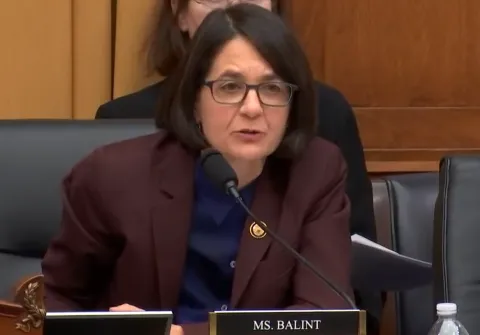
WATCH Rep. Balint’s opening statement.
Rep. Becca Balint
Subcommittee on the Administrative State, Regulatory Reform, and Antitrust
Hearing on “Anti-American Antitrust: How Foreign Governments Target U.S. Businesses”
December 16, 2025
Thank you, Chair Jordan, and thank you to our panel of witnesses for joining us today.
This hearing is nothing but a handout to Big Tech. These companies will oppose any rules to reform their anticompetitive conduct no matter what nation or state tries to hold them accountable. Republicans are concerned about other countries beating up on Big Tech? I’m concerned about Big Tech beating up on Americans!
Most Americans are struggling. Huge, dominant companies that don’t have real competitors are not being pushed to lower their prices or make their products better. We won’t make life in this country more affordable if we don’t commit to strong antitrust enforcement. Corporate greed is at the heart of rising prices.
The fact is that both parties have failed to check the consolidation of economic power and the abuses of that power. Dominant companies have grown larger under both Democratic and Republican administrations.
But here in the House Judiciary Committee, support for rigorous antitrust enforcement and merger review has been bipartisan.
It was this very subcommittee that studied the digital market, released a report, and crafted antitrust rules to rein in Big Tech. Those bills were supported and voted out of Committee by both parties. That was just a few years ago. But times have changed.
Our bipartisan antitrust legislation failed to become law because of opposition from factions in both of our parties. But work continued at the agencies.
The FTC and DOJ sued Big Tech for breaking the antitrust laws. Many of these suits began under Trump, were continued under Biden, and now are again in the hands of the Trump Administration.
In the Senate, Republicans like Senators Lee, Grassley, and Blackburn and Democrats like Booker, Klobuchar, and Blumenthal, are still working to pass the same antitrust rules that started in this Committee. Those bills are, rightly, targeted at Big Tech. For example, Senator Lee’s AMERICA Act would reform or break up dominant tech firms.
So why is it that today, here in the House, my colleagues across the aisle are characterizing those bipartisan bills as “anti-American.” Why?
Because they target multinational Big Tech companies that Chairman Jordan likes. Today, Republicans in this committee are showing the wide gap between them and other members of their party. And more important the gap between what they are pursuing today and what Americans want us to be doing.
Their Senate colleagues, the Vice President, and Trump appointees at the Justice Department and the FTC all support strong antitrust enforcement.
While our own government prosecutes American Big Tech companies for breaking the law and our Senate colleagues advance measure to hold Big Tech accountable, we are apparently supposed to criticize other countries for doing the exact thing that Americans want us to be doing.
Countries around the world, including Australia, Brazil, Japan, South Korea, the UK, and the EU, did what we did.
They studied the digital market, found dominant tech companies abusing their power and stifling competition, and then crafted rules and brought lawsuits.
The Majority’s witnesses will claim that these rules and suits are unfairly targeting American companies—but that premise ignores reality. Other countries are actually trying to address the monopolistic power of Big Tech. Power that poses dangers to markets, democracies, and public health. Power that can and must be checked through the enforcement of antitrust laws.
We should be world leaders on this. We’re Americans. Do we still believe in healthy competition? Why would we use time in this committee to blast others who are taking on the power of monopolies. Monopolies that are increasingly controlling our lives.
Republicans will argue today that actions by other nations to address monopolistic power are discriminatory and unfairly target U.S. tech companies. BUT the only true examples
of discriminatory and unfair law enforcement are right here at home. I have an idea–let’s clean our own house first.
The true threat to fair enforcement of antitrust law and to American companies is the perversion of antitrust undertaken by Trump and many in his Administration.
Under this President, principled and fact-based review of one company buying another is overruled in favor of deals struck by Hewlett Packard’s well-paid lobbyists with government officials over cocktails in a private club.
Under Trump, Paramount’s acquisition of Skydance was only approved after the President was paid tens of millions of dollars and a government spy was installed in the newsroom at CBS.
Under this administration, the President pardoned an indicted bid rigger. This is one of the few antitrust violations that are criminally prosecuted. The pardon came after the President played a round of golf with the alleged criminal’s lobbyist.
One round at Mar-a-Lago wipes away a possible ten-year prison sentence for a crime Trump’s own Justice Department and FBI worked to prosecute.
Keep in mind that the individual pardoned was set to be deposed the next day in a separate civil lawsuit, the government’s Live Nation-Ticketmaster case.
So in one fell swoop, Trump managed to undermine two cases important to protect Americans from being fleeced by corporate misconduct and greed.
The United States has long stood for something better: predictable enforcement, independent institutions, and decisions grounded in law and evidence.
When the administration treats antitrust as just another way to make a corrupt deal, when it weaponizes antitrust to achieve political goals and to reward its allies, it undermines the foundation of our market economy. Competitive merit–NOT political influence–should determine who succeeds.
Competition creates the pipeline of American innovation and prosperity. Isn’t that we want? Isn’t that what’s better for all of us?
Again and again, we have seen this administration do favors for their rich friends and allies while the rest of us suffer. Big Tech and big media are allowed to get bigger, raise prices, and squash competitors. All they need is a seven-figure payment to lobbyists and secret deposits into the President’s ballroom fund.
Companies are taking notice. They see that the “fate of any multibillion-dollar deal is going to run through the Oval Office.”
Right now, Warner Brothers is up for sale, and the two biggest bidders, Netflix and Larry Ellison’s Paramount are doing all they can to get the White House to favor their buyout over another.
Paramount is going to the White House and hanging out in the presidential box at the Kennedy Center. President Trump promised “sweeping” changes to CNN after he renewed his longstanding criticism of the news channel. Not to be outdone, Netflix executives have also paid homage to the president and visited the White House in recent days.
Americans of both parties see this and they don’t like it. They want us to fight back. We should be doing all we can to address the real and present dangers that monopolies, especially media and tech monopolies, pose to our markets, our wallets, to consumers, to competitors, and to our democracy.
Big Tech and big media are more than happy to pay to get their mega-merger approved or evidence against them thrown out.
They close deals that lead to even more private economic power and control over what we watch, what we buy, what we see, and what we hear.
Our Chair, Jim Jordan, has long opposed bipartisan antitrust bills aimed at reining in giant tech companies and cracking down on their abusive business practices. In 2021, when we advanced bipartisan tech antitrust bills, he called them “democrat bills” despite the support the bills continue to have from Republicans like Senators Grassley, Lee, and Blackburn.
And now we are supposed to beat up on other countries for doing what we attempted to do? Give me a break.
Big Tech money, secret million-dollar donations, and back-room deals cannot be how this country enforces the law. We must fight against monopolies wherever we find them. AND we cannot and should not criticize other nations for addressing the Big Tech’s global harms.
I call on my colleagues to join me in standing up for the rule of law. For antitrust and competition laws to be enforced on the merits and the facts, not handshakes, favors, and pay-for-play schemes.
I look forward to hearing from our witness, Professor Roger Alford, about how far we have perverted the rule of law and what we must do to ensure that transparency, accountability, and justice rule the day.