
Ranking Member Scanlon’s Opening Statement at Subcommittee Hearing on Republicans’ Scheme to Weaponize the Census for Political Gain
Washington, D.C. (November 19, 2025)—Today, Rep. Mary Gay Scanlon, Ranking Member of the Subcommittee on the Constitution and Limited Government, delivered opening remarks at a subcommittee hearing examining Republicans’ disregard for legal and historical precedent as they desperately attempt to weaponize the census for purely political ends.
Below are Ranking Member Scanlon’s remarks at today’s hearing.
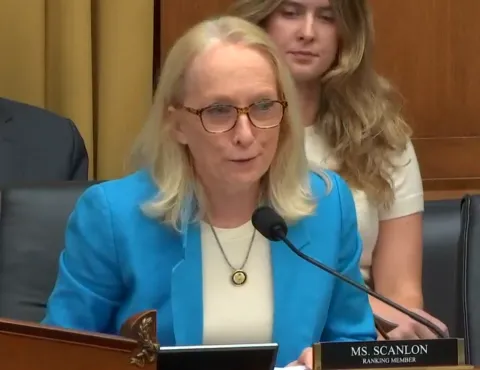
WATCH Ranking Member Scanlon’s opening statement.
Ranking Member Mary Gay Scanlon
Subcommittee on the Constitution and Limited Government
Hearing on “Enumeration or Estimation: Why Inaccurate Census Results Hurt American Citizens”
November 19, 2025
Good morning, and thank you to our witnesses for being here, I look forward to hearing from you.
As our founders recognized, the census is fundamental to our democracy, playing a critical role not just in governance, but in shaping decisions made by organizations and institutions across American life. An accurate census is essential for a fair distribution of political power here in Congress and for the equitable allocation of billions of dollars of federal funds to states and communities, including for programs like Medicaid, free and reduced school lunches, Head Start, and SNAP.
Its data is used by businesses and non-profits to determine where and how to operate, and by state and local governments to decide where to invest in public infrastructure, like roads, hospitals, and schools.
But the census is not just some mathematical equation to distribute Congressional seats or taxpayer dollars. It’s deeply rooted in our founders’ vision of what a government by and for the people should be.
As Alexander Hamilton said during the Constitutional Convention in Philadelphia, “[ t]here can be no truer principle than this—that every individual of the community at large has an equal right to the protection of government.”
Ultimately, the census is a national snapshot we take every ten years that helps us understand and define who we are and how to govern ourselves, and undermining that process in ways that distort that picture harms all of us. That’s why Democratic and Republican Administrations alike have historically tried to protect the census from political interference and partisan pressures. But, this president and his MAGA allies are deviating from that precedent, once again trying to rig things in their favor.
These efforts aren’t new. They began when the first Trump administration tried to add an unprecedented citizenship question to the census. This was a blatant attempt by political appointees to exclude non-citizens from our count, which they expected to benefit "Republicans and non-Hispanic whites,” and which was ultimately rejected by the Supreme Court.
And those efforts continued with the development of the right-wing Project 2025 Manifesto, which, as predicted, has become the Trump administration’s playbook, and which devotes a whole section to plans to appoint political appointees loyal to the White House to lead the census, in order to “execute a conservative agenda,” meaning: trying again to add a citizenship question, focusing census engagement on conservative groups, and limiting efforts to engage historically marginalized and undercounted groups.
Then, earlier this year, President Trump reinstated a memorandum to the Commerce Department ordering that the census not count undocumented immigrants when determining each state’s share of Congressional seats, despite the Constitution’s command that the “whole number of persons” be counted. He also posted on social media that he instructed his administration to start work on a “new” census, a statement that, in a common theme of his administration, blatantly ignores the fact that the Constitution gives Congress—not the President—the authority to conduct the census.
Our Constitution’s framers understood the importance of having an accurate and comprehensive population count. That’s reflected, of course, in the fact that Article I, Section 2, Clause 3—the Enumeration Clause—mandates that Representatives be apportioned among the states according to “the whole Number of . . . Persons” in each state using an “actual Enumeration.”
Later on, the drafters of the Fourteenth Amendment kept this phrasing while amending the Clause to account for the end of slavery, reiterating that a state’s representation in Congress must be determined by “counting the whole number of persons in each State”
It couldn’t be clearer: the census must count the “whole number of persons”—not just a subset of persons—living in the United States. And while the Constitution’s drafters could’ve used a narrower term like “citizens,” which they did, for example, in other parts of the Fourteenth Amendment, they purposely used the broader term “persons” in the apportionment provision—making it clear that all people count, including women—who could not yet vote—children, indentured servants—who were often immigrants—and former slaves. And they rejected proposals that would restrict the census to voters.
Additionally, the requirement of an “actual Enumeration” has never meant that census takers are only required to count those they can only reach directly. We know that the effort to count each person every decade has never been perfect, despite the best efforts. That’s for a variety of reasons, chief among them being that certain populations are difficult for census takers to reach.
But, the Constitution accounts for this. The Supreme Court made clear in Utah v. Evans that the Constitution doesn’t specify exactly how the census should be counted.
As the Court notes in that case, census takers implementing our very first count in the late 1700s were only required to report the names of household heads—very different from our system now. Our Framers knew better than to try and anticipate the technology or methodology that America would need to conduct the count in the future—one that must capture the hundreds of millions of people living in our country today.
Instead, the constitutional North Star they gave us for the census is simply that the count be accurate. These ongoing efforts to cast doubt about the results of the 2020 census—the census that was conducted, I should add, while Donald Trump was president, are part of a larger scheme, one MAGA extremists have designed to redraw maps mid-decade in a blatant power grab so that Republicans can win more seats in Congress and keep their majority, despite the increasing unpopularity of their Project 2025 agenda. In effect, they seek a “pre-gerrymander.”
The ongoing lawsuit in Florida, which seeks to overturn the 2020 census by challenging some of its counting methodologies, fits right into this plot. The suit, filed against a Trump administration that’s presumably sympathetic to the plaintiffs, may be just the pretext that this administration needs to push for a census redo.
But if their efforts succeed, Americans will suffer. Undercounts and other counting errors particularly hurt vulnerable and hard-to-reach populations, including: young children, racial and ethnic minorities, the transient and homeless, those in nontraditional housing arrangements, and those living in very rural or dense urban communities
In other words, people living in America, who patronize its businesses, drive on its roads, attend its schools, and use its essential public services—people who must be included in the count. If these lawsuit plaintiffs get their way and the methods used to account for these populations are prohibited, we’ll only move farther away from, not closer to, an accurate and complete count.
Federal funds would be misdirected, states, local governments, businesses, nonprofits, and others would make less-informed decisions, inadvertently depriving people of what they need to live and thrive in their communities. And that would be a devastating result for millions.
Of course, we all want the picture our census paints to be fuller and more accurate. It’s what our democracy demands. And we should all strive to improve our data collection and prevent undercounts as we look forward to the scheduled, regular 2030 census.
But, to make that a reality, we instead should talk about reforms that limit the executive branch’s ability to interfere in the count, as it's trying to do now, or reforms to ensure the U.S. Census Bureau has adequate funding and flexibility to do the job right.
We shouldn’t try to curtail or ignore the scientific methods available to us to complete such a huge undertaking or consider changes that make people trust this process and participate in it less, not more. The census and its results are too consequential for that.
I yield back.