
Ranking Member Raskin’s Opening Statement at Subcommittee Hearing on Trump’s Disregard for America’s Cybersecurity
Washington, D.C. (January 21, 2026)—Today, Rep. Jamie Raskin, Ranking Member of the House Judiciary Committee, delivered opening remarks at the Subcommittee on Oversight hearing on foreign threats to U.S. infrastructure, making clear that while Republicans talk about national security, Trump has dismantled the agencies that protect us and cozied up to the adversaries we should be defending against.
Below are Ranking Member Raskin’s remarks, as prepared for delivery, at today’s hearing.
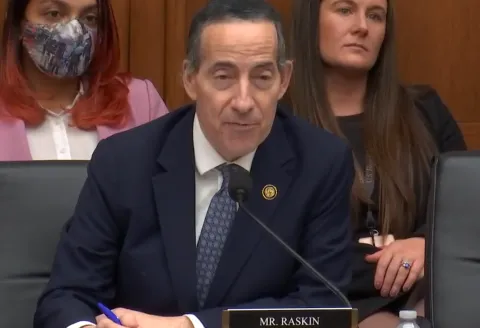
WATCH Ranking Member Raskin’s opening statement.
Ranking Member Jamie Raskin
Subcommittee on Oversight
“Embedded Threats: Foreign Ownership, Hidden Hardware, and Licensing Failures in America’s Transportation Systems”
January 21, 2026
Thank you, Chairman Van Drew, and thank you to the witnesses for being with us here today.
To the extent my colleagues across the aisle are holding this hearing to examine how foreign threat actors are compromising our national security by targeting transportation and other critical infrastructure, that is a valid and meaningful subject of inquiry and I salute the Chairman for this initiative.
China is in strategic competition with the United States, and that often involves use of cyber espionage to undermine our defenses. Cybersecurity has lately become a particular concern for the transportation sector because of the vast number of targets, operating new technologies, run by a wide array of government and business entities. From AI-driven software to chip-reliant hardware, advancement in technology has great promise to make transportation faster, cheaper, and safer. But we must be vigilant to ensure these systems aren’t vulnerable to infiltration or attack from malign actors, and I’m looking forward to exploring this issue with our witnesses today.
This is an important discussion, and it is also a nuanced discussion because of the breadth of businesses involved, the state and local governments enforcing the rules, and number of Americans who use our transportation infrastructure every day.
But we cannot honestly discuss and debate the issue without addressing how Trump has gutted safeguards that protect our transportation and critical infrastructure against foreign threats. The programs and people in the U.S. government who keep us safe are being cut wholesale and politicized, jeopardizing our security. Trump removed a third of the workforce at the Cybersecurity and Infrastructure Security Agency, which helps government and businesses work together to identify cyber threats before it’s too late. That reduction included the department dedicated to local government and business coordination, which is crucial to transportation infrastructure security. Trump fired the chairman of the joint chiefs and other top-level military leadership, eliminating national security continuity. And his attorney general shuttered the FBI’s Foreign Influence Task Force, the group responsible for identifying and combating malign foreign influence operations targeting the United States.
Trump’s approach to national security, especially cybersecurity, is that of a coach who’s friendly with the coaches of foreign teams and then suddenly takes his goalie off net. So to my mind, I don’t think we can have a serious conversation about hardware vulnerabilities as though their president hasn’t made our infrastructure substantially less safe over the last year. But what’s even more befuddling about today’s hearing is that we are examining foreign threats as though Donald Trump is not ceding more global power to China every day.
During his first term, Trump received millions from the Chinese government and state-owned companies. In exchange, he opposed sanctions against Chinese telecommunications companies and banks even when they threatened our national security. He even tried to cancel military exercise with Japan and South Korea because China and Russia complained.
And his second term has been more of the same. Over the last year, the Trump Administration has dismantled USAID, giving China free rein to swoop in and offer countries around the world assistance with infrastructure, construction projects, agriculture, and public health, strengthening its international sphere of influence. Trump has also hurt American consumers by imposing unlawful and arbitrary tariffs; and hamstrung our ability to respond to threats by firing government workers, including experts on China and national security personnel. All this while using his cryptocurrency ventures to pocket millions of dollars from Chinese billionaires with ties to the CCP. In May, a tiny Chinese technology company with ties to the government announced it had bought as much as $300 million of President Trump’s memecoin—despite it having no revenue and only 8 employees.
One year into Trump’s second term, we’ve learned that other countries think Trump is making China great—not the United States. In a 21-country poll by the European Council on Foreign Relations, the majority of people around the world said that while the U.S. is less feared by its traditional adversaries, they expect China’s global influence to grow over the next decade. And it’s no wonder they think that, when Trump is inviting China, a known human-rights-violator, to join the Gaza Board of Peace; and reverses course and allows U.S. chip exports to China, in a move that Anthropic CEO recently likened to “selling nuclear weapons to North Korea.”
So, my friends, I wish this could just be about the problem of hardware technology in transportation, but it exists in this larger political context, and I think that we have to make that clear for everyone if we are serious about confronting the problem of Chinese and Russian tyrannical influence in our government.
Thank you, Mr. Chairman, I yield back.