
Ranking Member Raskin’s Opening Statement at Subcommittee Hearing on Trump’s Corruption of Antitrust Enforcement
Washington, D.C. (December 16, 2025)—Today, Rep. Jamie Raskin, Ranking Member of the House Judiciary Committee, delivered opening remarks at the Subcommittee on the Administrative State, Regulatory Reform, and Antitrust hearing on how under President Trump, corruption and favoritism is replacing law and facts as the cornerstones of the government’s antitrust agenda.
Below are Ranking Member Raskin’s remarks, as prepared for delivery, at today’s hearing.
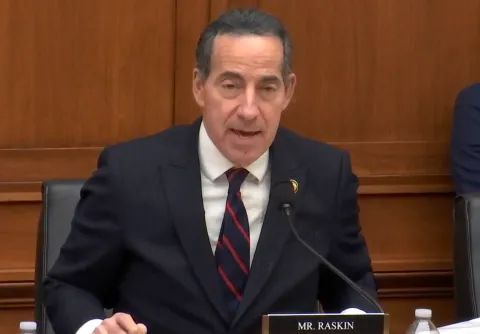
WATCH Ranking Member Raskin’s opening statement.
Ranking Member Jamie Raskin
Subcommittee on the Administrative State, Regulatory Reform, and Antitrust
Hearing on “Anti-American Antitrust: How Foreign Governments Target U.S. Businesses”
December 16, 2025
Thank you, Chair Jordan, and to all our witnesses for joining us today.
Today is just the second time this Congress that an Administration official testifies before the Judiciary Committee, and when we hear Roger Alford’s testimony, everyone will understand why they’re not testifying about what’s going on behind closed doors over there.
In April, Alford began serving as Principal Deputy Assistant Attorney General in the Antitrust Division—which is the number two spot in Antitrust.
By July 2025, Professor Alford, was fired for “insubordination,” after he blew the whistle on DOJ’s corrupt approval of a merger between Hewlett Packard Enterprise and Juniper Networks. Although the Antitrust Division strongly opposed the merger, its opposition was overridden by Attorney General Pam Bondi’s then Chief of Staff, Chad Mizelle, and her then-counselor, Stanley Woodward, after Hewlett Packard lobbyists urged them to ignore and bypass the sweeping antitrust problems they had identified.
Professor Alford, thank you for sounding the alarm today about backroom corruption, political favoritism, and betrayal of the rule of law at the Department of Justice. We are grateful you have the courage to speak out before the Committee today and we commend your commitment to transparency, public integrity and fair enforcement of the law.
Our Republican Colleagues have called this hearing “Anti-American Antitrust.” But they’re not interested in dismantling monopolies, collusion or price-fixing. On the contrary, their policy is all about elevating the largest corporations—especially the ones donating directly to Trump and MAGA—over the public interest and putting them far beyond the reach of all the U.S. and foreign antitrust laws.
Our expert agencies, like the FTC, the FCC and DOJ, review mergers to assess whether a proposed deal complies with the relevant antitrust laws or public interest standard, including by protecting U.S. consumers from rising prices. If, after applying the law to the facts, they find that the merger is not in the public interest, they can sue to stop the merger or propose conditions on any new combination.
But under this administration, merger review has turned into one more instrument for corruption, a way for the President to reward his rich insider friends and punish companies he dislikes—including news companies that have been critical of his Administration. Antitrust enforcement is now driven by pay-to-play corruption, political favoritism and retaliation, and bribery instead of the facts and the legal standards. It is not the public interest that controls outcomes, but the President’s political and financial interests.
Take the case of Hewlett Packard Enterprises’ purchase of Juniper Networks. When DOJ, under this Administration, moved to block the merger, Hewlett Packard Enterprises hired two lawyers with connections to the President and his men, Mike Davis and Arthur Schwartz, for one million dollars each, to lobby the White House, Attorney General Bondi’s chief of staff, Chad Mizelle, and the Attorney General’s Counselor, Stanley Woodward. Although DOJ staff and Trump’s head of the antitrust division, Assistant Attorney General Gail Slater, strongly opposed the merger of these two large companies, the lobbyists got Mizelle to ignore not just the facts and the law but also the recommendations of Trump’s own antitrust team—to bless the deal.
We don’t know what these lobbyists told Mizelle over cocktails in a private club in DC but we do know that he short-circuited DOJ’s legal review process and gave the green light to a merger that, according to DOJ’s own press release will “significantly reduce competition…resulting in large segments of the American economy paying more for less.”
This was a backroom deal that centralizes power and sends more wealth to the wealthy, making life a lot more expensive for the vast majority of Americans already struggling to stay afloat in Trump’s economy.
Or take Skydance’s acquisition of Paramount, which is owned by the Ellisons, close friends and big donors to President Trump who plied him with financial and political favors to ensure Paramount’s purchase of Skydance would go through. The company not only gave tickets worth about 12 thousand dollars to the soon-to-be Chair of the FCC, Commissioner Brendan Carr, but also collected Carr’s candid advice on how to effectively lobby his agency for approval. While Chair Carr sat on the proposed deal, the White House squeezed Paramount to pay President Trump $16 million dollars to settle an utterly frivolous personal lawsuit he filed about the way 60 Minutes edited an interview with Kamala Harris and pressured Paramount to give him an additional $20 million in free ads just for the hell of it. Even after this corrupt tribute was paid, the Trump administration extracted more, installing an informant or “minder” directly in the newsroom at CBS to make sure its news coverage would always be suitably pro-Trump, adding naked violation of the First Amendment to this bonfire of corruption.
Even now, the President is saying he personally “will be involved” in the process of Warner Bros.’s sale, emphasizing that CNN must “be sold” because of the news outlet’s discourteous coverage of his flailing presidency. And Netflix and Paramount both know that the person they really need to lobby on the proposed acquisition of Warner Bros. by either of their companies is the President himself, and so they have already gone to the White House to make their case.
This is how a gangster state runs, not how antitrust enforcement is supposed to work in the United States.
Every time corporations and lobbyists use political influence and money to thwart the merger review process, the American people lose. We get a marketplace with more corporate concentration and consolidation, reduced competition, less innovation and mired in political influence peddling. Prices go up, wages go down, the economic elite profits and economic inequality intensifies.
As our witness, Professor Alford, said of these lobbyists and their White House ties in August: “Regardless of the outcome, their commitment is to exert and expand their influence and enrich themselves as long as their friends and supplicants are in power.”
These cash-for-merger backroom deals reflect broader patterns of money corruption in this administration.
Antitrust law should never be twisted to create a gangster state and crony capitalism.
Today, we hear from Roger Alford about the difference between fair enforcement of antitrust laws and back-room deal making. I hope my Republican colleagues listen to him and take to heart the warning he shares about the economic costs of political corruption.
I yield back.