
Ranking Member Raskin’s Opening Statement at Subcommittee Hearing on Republicans’ Unconstitutional Effort to Restrict Religious Freedom
Washington, D.C. (February 10, 2026)—Today, Rep. Jamie Raskin, Ranking Member of the House Judiciary Committee, delivered opening remarks at the Subcommittee on the Constitution and Limited Government hearing on Republicans’ attack on religious freedom.
Below are Ranking Member Raskin’s remarks at today’s hearing.
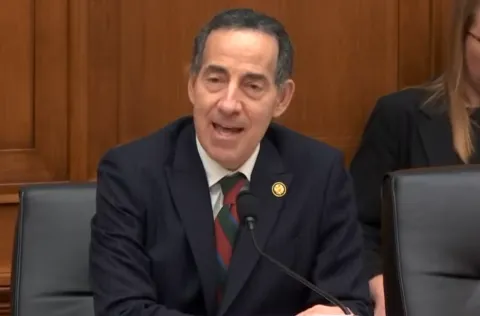
WATCH Ranking Member Raskin’s opening statement.
Ranking Member Jamie Raskin
Subcommittee on the Constitution and Limited Government
Hearing on “Sharia-Free America: Why Political Islam & Sharia Law Are Incompatible with the U.S. Constitution”
February 10, 2026
Thank you, Mr. Chairman, and thanks to the witnesses for joining us today.
We live in a country so great that we don’t need the anti-Sharia and anti-Muslim legislation our friends are proposing today because our Constitution already forbids theocratic imposition and Establishment of any kind, whether it is Christian white nationalism expressed in compulsory Ten Commandments displays, an Orthodox Jewish set-aside school district in New York or any effort to replace secular public law with a religious code, whether Sharia law, the Analects of Confucius, the Torah or anything else.
So this completely unnecessary hearing, another distraction from the Administration’s cover up of the Epstein files and the continuing brutal violation of people’s constitutional rights in Minneapolis, is a wonderful opportunity to remind ourselves why our Constitution has three essential religion clauses, and why they do all of the work that people are talking about doing today: the Establishment Clause, the Free Exercise Clause, and the Clause Guaranteeing No Religious Test for Public Office. And if you take time to study them, they will dispel all the anxieties stirred up by legislation and agitation like this.
Anything legitimate that our colleagues want to say about preventing the imposition of Sharia law in America is already accomplished by the Establishment Clause. So everybody can rest easy with Thomas Jefferson’s Wall of Separation between church and state that he identified in his famous letter to the Danbury Baptists.
Let’s say someone proposes that all public schools and government offices should post the core principles of Sharia law, which I don’t know what they are exactly, and I looked online and there were like 4 or 5 different versions. But let’s take one which said protecting religion, life, family, intellect, property and wealth. Another one said, protecting honesty, trustworthiness, mercy, humility, moderation and honoring promises. But whatever it is, if somebody said, we want to put Muslim Sharia law up in all the schools and all the government buildings, we would know very quickly how to deal with that because we’re not writing on a blank slate.
In fact, we’re in something of a furor over the laws compelling the posting of the Ten Commandments right now that were recently passed in Louisiana and Texas. But the Supreme Court already struck down such Ten Commandment laws in 1980, more than 45 years ago, in a case called Stone v. Graham, as a plain violation of the Establishment Clause, which forbids governmental endorsement of any religious text or any religious doctrine. We don’t even have one agreed upon version of the Ten Commandments. There’s a Catholic version, there’s a Lutheran version, there’s an Episcopalian version, many others you can find online. Which one would the government even endorse?
Well, we’ve got Members of this body who vehemently denounced Sharia law, but also agree with Louisiana and Texas that we should be posting the Ten Commandments of some particular sectarian variety up in the schools. When this came up last Congress, there were Members of the Oversight Committee who said we should not only be putting the Ten Commandments up in public schools, but in Congress in all public buildings. I told them the Ten Commandments have been doing fine for millennia without an endorsement by the Freedom Caucus in the House of Representatives.
One guy told me, well, you know, the Ten Commandments are the basis for the Bill of Rights. I was kind of confused because, you know, there are ten in each one. But I said, let’s test the proposition. The first commandment says, “Thou shalt have no other gods before me.” The First Amendment says, “Congress shall make no law respecting an establishment of religion.” So I don’t think the First Commandment dictates the First Amendment. They wanted to go to the floor and have an up or down vote on the Ten Commandments. I said, if we’re going to vote on the Ten Commandments in 2025, we should vote on each commandment separately. And you shouldn’t be allowed to vote on any commandment you yourself have ever violated. That would make more sense.
In any event, this is res judicata, it’s a closed case. The government cannot endorse Muslim law, Jewish law, Christian law, Methodist law, Baptist law, none of it. So we don’t need a special anti-Sharia law or a special anti-Sharia caucus. The First Amendment already takes care of it.
Well, anything illegitimate or discriminatory that our colleagues would want to selectively impose on Muslims is, conversely, a violation of the Free Exercise Clause and also forbidden by the Constitution. Muslims afraid that Congress might actually impose one of these anti-Sharia bills—and of course, they’re just introduced for political purposes, I don’t think they have any delusions that they’re going to pass Congress—but if you were afraid of that, all you would have to do is read the case law to understand why that can’t be done.
Check out, for example, a case with the wonderful name Church of the Lukumi Babalu Aye, Inc. v. City of Hialeah in 1992, where the city of Hialeah in Florida selectively banned animal rituals and sacrifice by people practicing the Santeria religion. And the Supreme Court shrewdly said, look, if you want to have general laws that apply to every religion and to every citizen that bans certain kinds of animal slaughter as cruel or unusual or particularly harmful, then you can do it. But you can’t pass a law that targets a specific religion. Justice Kennedy called it “religious gerrymandering.”
So, I don’t know, Mr. Chairman, about the East Plano Islamic Center, which sounds like a compound with a mosque and some residential and some restaurants and so on. And of course, those kinds of religious compounds exist all across America, whether we’re talking about the Amish, the Mennonites, Catholics, Jews, you name it, lots of those exist. But, they do violate a separate principle if the government actually clothes them with secular power. So I would agree with you if they’re giving them the power to set up their own police force, their own school system, that would violate the Supreme Court’s decision in a case called Kiryas Joel Village School District v. Grumet.
That was 1994, where New York created a separate public school district for members of the Satmar Hasidic Jewish religion in upstate New York. The Supreme Court said, no, you can’t endow a religious group with secular power. So if that’s going on there, then I’m with you. But if it’s not going on, then it’s just a compound. And if they own the property, it’s private property and they bought it. Why would we want to mess around with that? That sounds like you’re just vilifying and demonizing people because you don’t like their religion. And I know you wouldn’t do that.
Let me just say, finally, to uniquely blockade members of a particular religion here, Islam, from participating in government or politics, the kind of thing you do hear from people calling for Ilhan Omar to be expelled from Congress or deported from the country, that plainly violates Article VI, Clause 3 of the Constitution, which says “no religious test shall ever be required as a qualification to any office or public trust under the United States.”
So let’s repose some of our faith and trust in the Founders of the Constitution, the Establishment Clause, the Free Exercise Clause, the ban on religious tests for public office. They’ve been working pretty well for America. I think they take care of every single thing that anybody’s talking about in this hearing, and I do think we’d be much better off getting back to the work of the country right now, trying to deal with the runaway problem of inflation, or to deal with the problem of the continuing Administration cover up of the Epstein files. Any of those, I think, would be a little more valuable. Although, I’ve got to say, as a washed-up professor of constitutional law, I do welcome the opportunity to remind people about the First Amendment.
I yield back to you, Chairman Roy.