
Ranking Member Raskin’s Opening Statement at Subcommittee Hearing on Protecting Creators in the Age of AI and the Internet
Washington, D.C. (June 30, 2026)—Today, Rep. Jamie Raskin, Ranking Member of the House Judiciary Committee, delivered opening remarks at a Subcommittee on Courts, Intellectual Property, Artificial Intelligence, and the Internet hearing on how to address piracy, copyright theft, and privacy challenges in the age of artificial intelligence, when creators are increasingly being exploited as AI companies use their work without consent or compensation. Below are Ranking Member Raskin’s remarks at today’s hearing.
Image
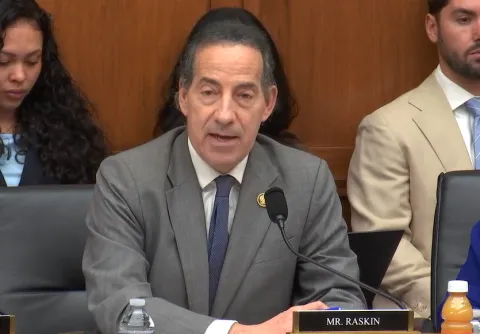
WATCH Ranking Member Raskin’s opening statement. Ranking Member Jamie Raskin Subcommittee on Courts, Intellectual Property, Artificial Intelligence, and the Internet Hearing on “A Midlife Crisis? IP and the Internet After 40” June 30, 2026 Thank you kindly, Mr. Chairman. Welcome to our witnesses. A couple of months ago, I got a postcard in my mailbox, which let me know that three books that I’ve written over the course of my career had been used to train Anthropic’s Claude AI large language models. And because of this, I was entitled to be part of the settlement in the Bartz v. Anthropic case. Now, this surprised me because, first of all, it reminded me that I used to write books. Now I just post 280 characters every day. But it also surprised me because I didn’t know anything about the litigation, much less did I know anything about the fact that Anthropic had essentially swallowed up the contents of three of my books, apparently rejecting the relevance and the utility of several other books I’d written. Anthropic had never called to ask me to use my books, but a judge found that Anthropic ingestion and digestion of my books without payment was fair use. Claude AI may not be allowed to simply reprint my book and regurgitate it line for line and sell it, but it may profit off of my word choice, my cadence, my style, such as it is, my conceptualizations and my research, among other attributes of my writing for free. Now if I finally get around to filling out the form, which means I have to finally get around to finding the postcard, I may get a de minimis check in the mail, because the judge did find Anthropic had used pirated versions of the books to train its large language model, and the parties, including apparently me, settled shortly after this holding. Now, we’d be cavalier to write these training episodes off as random or minor incidents. AI companies intentionally select works with which to train their large language models, often with zero intention of paying the creators any royalties for use of their creative intellectual labor. Bartz v. Anthropic is just one ominous decision floating in a sea of developing case law in this brave new world, to engage in a fair use vernacular borrowing of H.G. Wells’ famous work of science fiction, but it’s illustrative of the proliferating tensions between existing law and social values that have materialized as we live through this time of astonishing technological transformation. The advent of the internet and the explosive emergence of AI have fundamentally changed the way that we interact with each other, the way we conduct business, the way we think about human thought, human feelings and human work, and the way we create and consume books, songs, and other creative works. Now I tend much more to the heady enthusiast side of such changes over the brooding luddite side when it comes to technological innovation. But that’s only because I have a profound faith in democracy, in our capacity to manage technological change when we put our minds to it. So now is the time to pose and grapple with urgent and uncertain questions about the moment. How do we integrate titanic, new technological changes in a way that supports rather than undermines the basic needs and values of our society? We know from experience that innovations mean little if they are left to create inequality and domination, joblessness and poverty. How do we prevent the concentration of power and wealth but instead work to fairly distribute the benefits of new technologies so they become part of our common life and inheritance? In this new era, we must ask ourselves what is fair and what is just, and what will secure the greatest good to the greatest number of people. And that’s what I hope we will be doing today. When the DMCA became governing copyright law nearly 30 years ago, dangerous products and merchandise that infringed on intellectual property rights overwhelmingly had to be bought in person. Movie and music pirates created physical copies of recordings and literally sold them on the street corners. Our laws did not contemplate the spread of streaming, where content piracy occurs on a daily basis all over the world, as far away as Vietnam and the Philippines, and the pirates can create a new infringing site the moment one gets taken down. Consumer products used to be bought almost exclusively in stores, with the occasional counterfeit handbag on the street. Today, harmful counterfeit products like exploding batteries, toxic baby cream, and asbestos laden crayons can be bought often, usually unwittingly, by consumers online, and they arrive at their doorsteps in a matter of hours. Even our music laws were designed for a world where listeners discovered music through their stereos, which is why we are left with laws that prevent performers from being paid when their music is played on the radio. These issues affect not just the 2 million employees of the movie industry, or the nearly $12 billion in revenue from the music industry, but also the consumers who end up paying the cost of counterfeit goods that break or cause harm or just drive up the price of the real product. The laws on the books may no longer be fair for these affected industries, and they are almost certainly unfair to consumers. I understand there are many proposals out there with ideas for improving on the current situation. I’m a proud co-sponsor of one of them, the American Music Fairness Act, which would ensure that performers are paid when their music is played on the radio. In many ways, AI has supercharged the problems that have been percolating since the advent of the internet. Generative AI models allow us to use the internet faster, more accurately, and beyond our individual technological capacities, but our laws have not kept pace with all the changes. Our intellectual property laws were created at a time when it was safe to presume that one must be human to have cognition and intellect. Some would argue that’s no longer the case. It’s long past time we considered how to continue protecting the creative fields and address the ramifications of the proliferation of deep fakes, training AI models on copyrighted material, and other areas where AI may be unfair to both consumers and creators. I know some of my colleagues want to do away with the regulation of AI companies altogether, but we can protect content creators and help businesses thrive at the same time, we don’t have to choose. Congress should help provide for the safe adoption of generative AI models that take into account the environmental, labor, and social consequences of such technology, and we should do so while allowing the states to experiment with different approaches. I’m dismayed by those who have caved to a small group of billionaires and now a trillionaire who own these AI models and have proposed broad preemption of state common law, causes of action, and state legislative decision making with no federal regulation at all. There’s no reason we should do away with common law tort claims that act as the basic national safety net for fairness. The National Institute of Science and Technology should absolutely be allowed to test frontier models. And if AI models are being built on the hard work of artists, writers and inventors, we should be thinking long term to ensure that there are more artists, writers and inventors a generation from now, creating material to sustainably train the next wave of generative innovation to come. The rational next step for this Committee is to ask ourselves how we can map a path forward for all Americans to use technology while ensuring laws that protect consumers and creators, workers and families. Thank you, Mr. Chairman. I yield back to you.
|