
Ranking Member Raskin’s Opening Statement at Subcommittee Hearing on Organized Retail Crime
Washington, D.C. (December 17, 2025)—Today, Rep. Jamie Raskin, Ranking Member of the House Judiciary Committee, delivered opening remarks at the Subcommittee on Crime and Federal Government Surveillance hearing on protecting consumers and businesses from organized retail crime.
Below are Ranking Member Raskin’s remarks, as prepared for delivery, at today’s hearing.
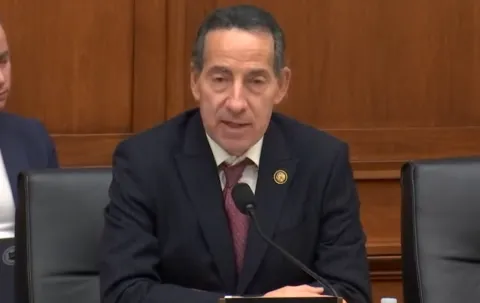
WATCH Ranking Member Raskin’s opening statement.
Ranking Member Jamie Raskin
Subcommittee on Crime and Federal Government Surveillance
Hearing on “Protecting Consumers and Businesses: Confronting Organized Retail Crime”
December 17, 2025
Thank you, Chairman Biggs, and thank you to the witnesses for being with us here today.
In recent years, retailers have emphasized that organized retail crime has grown to become a significant threat both to public safety and to the retail economy—threatening the viability of businesses like cargo brokers, shippers, big box stores, and online marketplaces, as well as the safety of the people who work at these businesses.
Although we lack a clear definition of “organized retail crime,” we know what the essential problem is: criminal enterprises that operate in a coordinated manner to commit large-scale theft of merchandise for resale, or to defraud retailers and convert the proceeds into cash or cryptocurrency.
This is not petty shoplifting. It is a multibillion-dollar industry that evolves and adapts almost daily to the latest technological trends, improvements in security, and modified business operations.
Social media and local news reports are filled with videos of smash-and grabs and mobs raiding cargo containers. These accounts are shocking—but they are just the tip of the iceberg. Criminal networks recruit people to steal (or boost) specified merchandise from retailers—sometimes paying the boosters’ travel expenses—then fence these stolen goods online, shipping them across state and sometimes national borders, and arranging resale of the merchandise to other stores, or even returning them to the retailer they stole them from in the first place!
Others steal hundreds of gift cards from retailers. They then peel off the label to obtain the unique code on each card before doctoring them up to look new, returning them back to the store shelves and using customized software to track the card numbers online. When unsuspecting customers eventually purchase the cards and load them with value—say, $20, $50, or $100 for a favorite nephew’s holiday gift or $500 for a newlywed couple—the thieves can drain all the money off the card for themselves, remotely, in this diabolically clever scam.
The customer only finds out what happened if their disappointed nephew or the newlyweds complain about getting a gift card with nothing on it.
It is increasingly clear that these kinds of operations, at this scale, are coordinated, enabled by modern technology and communication tools, and hard to stop.
State and local law enforcement agencies are our first line of defense against organized retail crime—but state and local officials have limited resources and authorities to investigate and prosecute crimes that cross state lines and even international borders.
In recent years, federal agencies have taken some interest in tackling this problem. But federal prosecutors tend to focus their own limited resources on the largest, most brazen schemes, especially those involving theft of large amounts of cargo or thefts that amount to losses in the tens of thousands of dollars.
Many organized retail theft schemes remain too complex for state prosecutors and too modest for federal prosecutors, creating a growing enforcement gap.
As this Committee grapples with the problem of organized retail crime, I see two fundamental challenges.
First, we need better data.
Because retailers, retail organizations, and law enforcement agencies all track organized retail crime using different definitions and different methods, we have a hard time canvassing the scope and dimensions of this problem or formulating an effective targeted response. In some cases, retailers are targeted by the gangs for weeks or even months before it becomes clear that they are the victims of organized retail crime.
If we are going to tackle this problem, we need standardized national data that utilizes a consistent, widely accepted definition of “organized retail crime.” We cannot dismantle these criminal networks until we have a precise understanding of how they operate and how much damage they really cause.
Second, we need to see better coordination between federal law enforcement agencies and state and local counterparts. A national task force could be instrumental in finding the broader patterns in local incidents and conducting complex investigations across state lines.
I would hope that any such task force would be nimble enough to follow organized retail crime as it evolves. In 2022, Congress passed the INFORM Consumers Act to bring more transparency to online transactions on certain platforms.
But perpetrators of organized retail crime took note and moved their operations to smaller platforms not covered by the law. A national task force would help us make sure our laws are keeping up with the criminals and ensuring law enforcement at all levels is empowered to counter and put a stop to organized retail crime.
I am glad that we have this diverse panel here today to share expert knowledge and experience, and discuss solutions that will better protect employees, consumers, and communities across the country.
I thank the Chairman and I yield back.