
Ranking Member Raskin’s Opening Statement at Subcommittee Hearing on How Trump’s Soft-on-Drug Policies Are Making Americans Less Safe
Washington, D.C. (March 18, 2026)—Today, Rep. Jamie Raskin, Ranking Member of the House Judiciary Committee, delivered opening remarks at the Subcommittee on Oversight hearing examining how the Trump Administration is making Americans less safe by pardoning drug kingpins, disbanding anti-drug trafficking task forces, and diverting federal agents away from investigating drug cartels.
Below are Ranking Member Raskin’s remarks, as prepared for delivery, at today’s hearing.
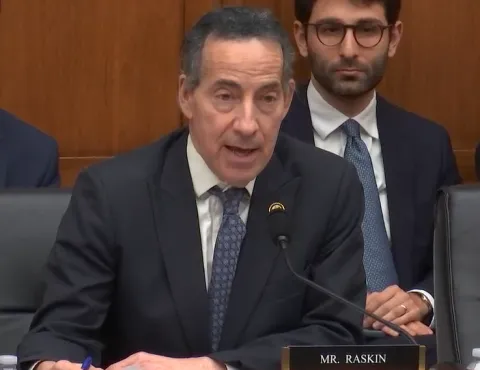
WATCH Ranking Member Raskin’s opening statement.
Ranking Member Jamie Raskin
Subcommittee on Oversight
“The Legal Basis for Action Against Venezuelan Drug Traffickers”
March 18, 2026
Thank you, Chairman Van Drew, and thanks to our witnesses.
Since this summer, this Administration has launched more than 40 strikes on alleged “drug boats” in international waters, mostly in the Caribbean, killing at least 157 people.
This is without any declaration of war. I am also moved, like Ms. Crockett, by all the young people here today. And I just want to remind you to read your Constitution because in Article I, Section 8, Clause 11, it gives Congress the power to declare war. The founders of our country were so adamant about this. James Madison wrote a letter to Thomas Jefferson specifically on the subject, saying that the kings were constantly plunging their countries into wars of conceit and vanity, imperial avarice and corruption. And it had to be the Representatives of the people who decide to go to war and not one guy. So today, not Donald Trump, not J.D. Vance, not Tulsi Gabbard. It’s got to be the Representatives of the people. But, as with what’s taking place in Iran today, there’s no declaration of war.
As I survey the spectacular wreckage of this Administration’s drug enforcement policy, I am reminded of Talleyrand’s famous quote about Napoleon murdering one of his cousins: it’s “worse than a crime, it’s a mistake.”
This is, of course, a crime and this is murder—plain and simple. The Administration has not provided any plausible legal justification under domestic or international law for Donald Trump to use the U.S. military to kill whoever he unilaterally deems a ‘terrorist’. If these individuals were on U.S. soil, they would be arrested based on probable cause (if it exists) indicted, tried, and convicted or acquitted, consistent with our constitution. Even out at sea, our Coast Guard knows how to interdict a ship and take its sailors into custody. In this country, under this Constitution, we arrest and prosecute people who commit crimes; we don’t blow them out of the water with a Hellfire missile. Donald Trump was prosecuted, tried, and convicted of dozens of counts of criminal fraud, and our colleagues STILL think he's innocent, but they don't want to give other people the most basic elements of Due Process.
But these boat strikes are also spectacular and costly mistakes, a made-for-TikTok distraction covering up this Administration’s completely ineffectual drug policies, and preventing us from focusing on government policy that really works.
Under the Biden Administration, the United States saw the largest drop in opioid and fentanyl overdose deaths in history, from 80,000 in 2023 to 54,000 in 2024. West Virginia opioid deaths declined by 46%. In Wisconsin, they declined 44%.
But President Trump appears to be doing everything in his power to reverse this progress with his characteristic recklessness and bravado. Just a few months ago, Trump slashed staffing at the Substance Abuse and Mental Health Services Administration (SAMHSA) by 50%, terminated $1.7 billion in SAMHSA block grants for state health departments, and cut $350 million in addiction and overdose prevention funding in 2025. His one Big Ugly Bill cut tens of billions from Medicaid, which provides health coverage to nearly half of all adult Americans who have an opioid use disorder.
Mr. Chairman, this is not a video game – it’s a national public health and medical emergency. You can’t bomb your way out of a fentanyl crisis.
Even in the fight against drug traffickers, the Administration’s tough on drug policies have been little more than a paper tiger. More than 5,000 FBI and DEA agents have been reassigned from combatting drug cartels to immigration enforcement, just to meet Stephen Miller’s obscene immigration deportation quotas. Last year, Attorney General Bondi terminated DOJ’s Organized Crime Drug Enforcement Task Forces (OCDETF), a long-standing strike force created by the famously “soft on crime” Republican President, Ronald Reagan, which allowed DOJ to coordinate the agencies investigating cartels and transnational criminal networks. Over the last four decades, OCDETF task forces conducted more than 37,200 investigations of criminal drug and trafficking enterprises, leading to the conviction of over 321,000 defendants, the seizure of $13.4 billion in cash and property, and the seizure of over 870,000 weapons.
Our witness today, Thomas Padden, is the former Acting Director of the Organized Crime and Drug Enforcement Task Force. As a nonpartisan law enforcement professional, Mr. Padden can testify to the former efficacy and utility of OCDETF when it comes to dismantling drug trafficking networks. And he can explain just how dangerous the Administration’s elimination of these proven law enforcement tools will be and have already been.
The Trump Administration claims it launched these deadly boat strikes because the Maduro regime was bringing cocaine into the United States and Trump is a tough and determined fighter of cocaine.
But last year, President Trump pardoned Juan Orlando Hernández, the convicted mega-cocaine trafficker and disgraced former President of Honduras. Hernández turned Honduras into a full-blown narco-state and used his presidency to operate one of the largest and most violent drug-trafficking conspiracies in the world. When asked why, why, Trump would pardon a narco-trafficker responsible for shipping 400 tons—that’s more than 800,000 pounds—of cocaine into our country, President Trump responded that the decade-long investigation into Hernández was nothing more than a “Biden setup”—a remarkable claim given that it was Trump’s own former defense attorney, former-DOJ senior official, and now hand-picked federal judge Emil Bove, who helped build the case against Hernández and his family during Trump’s first term.
But Hernández the coke smuggler and dealer who was taped saying “we’re going to shove the cocaine up the noses of gringos” had connections to longtime Trump allies, including Roger Stone.
If you think the shocker pardon of Hernández just 1 year into his 45-year sentence was an unusual lapse in judgment for our king of pardons, President Trump also pardoned Ross Ulbricht, the founder and former head of Silk Road, a website that facilitated more than 1.5 million illegal drug transactions. Prosecutors described Ulbricht as “the kingpin of a worldwide digital drug-trafficking enterprise” for his role in operating the crypto-powered online black market, which facilitated the sale of cocaine, heroin, and other deadly drugs to American communities. Not content to simply help sell drugs, Ulbricht also solicited six murders-for-hire in connection with operating the site. And yet President Trump pardoned him, along with January 6th rioters, known fraudsters, and others with connections to drug dealers and the MAGA crowd.
This drug kingpin friendly Administration has cut health care funding for Americans suffering from opioid use disorder, pardoned narco-traffickers, and dismantled the law enforcement apparatus that actually combats drug trafficking and protects American lives. Federal drug prosecutions dropped by 10% last year.
This new “shoot first ask questions later” approach to the war on drugs has not substantially stopped any drugs from coming into the country. For decades, the U.S. Coast Guard stopped the same boats we are blowing up now. We have not stopped any fentanyl from coming into the United States, the drug primarily responsible for killing Americans, since Venezuela does not produce or export any substantial amount of that drug.
These strikes also fundamentally weaken our ability to bring cases against drug kingpins or the networks that actually sent these drugs, since we are blowing up the lower-level witnesses needed to indict higher-level operators. We are quite literally murdering the lowest offenders – not to mention potentially completely innocent fishermen – while letting the drug kingpins, the kind of people Trump pardons, walk free. No, this policy was created for one reason and one reason only: to make some cheap social media content for MAGA.
And it’s not just the pardons that make no sense. ICE’s obsession with meeting Stephen Miller’s obscene deportation targets has led to them to detain individuals who should be standing trial for their drug offenses. In a number of cases, state drug cases have been delayed or dismissed all together where defendants detained by ICE have failed to appear in court. One judge was forced to dismiss a case against an individual working with the Sinaloa drug cartel because he was in ICE custody.
The billions of dollars these unlawful and ineffective military executions cost could be used to save American lives. We could fully restore SAMSHA funding; we could support rural hospitals that are on the frontline of the addiction crisis. We could be investigating drug traffickers and prosecuting more drug cases. But Pete Hegseth needs his clicks, and so we continue bumbling down this ineffective, inexplicable, and counterproductive path.
It’s not just a crime; it is a mistake.
I yield back.