
Ranking Member Raskin’s Opening Statement at Spotlight Forum on Live Nation–Ticketmaster Monopoly
Washington, D.C. (May 18, 2026)—Today, Rep. Jamie Raskin, Ranking Member of the House Judiciary Committee, delivered opening remarks at a bicameral spotlight forum examining the Live Nation–Ticketmaster monopoly and a controversial Department of Justice (DOJ) sweetheart deal that undermines antitrust enforcement and rips off consumers.
Below are Ranking Member Raskin’s remarks at today’s hearing.
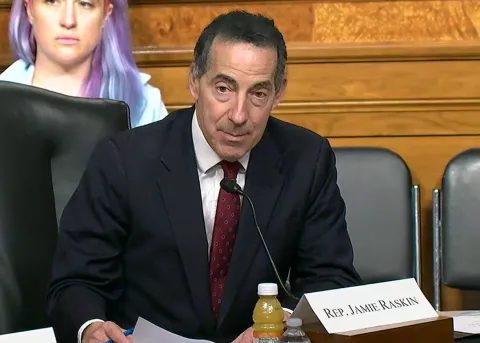
WATCH Ranking Member Raskin’s opening statement.
Ranking Member Jamie Raskin
House Judiciary Committee
Democratic Spotlight Forum on “Corruption Takes Center Stage: How the Live Nation–Ticketmaster Settlement Threatens Antitrust Enforcement”
May 18, 2026
Millions of Americans have had the exact same experience of logging in to buy tickets to see music in concert and finding the costs are extraordinarily high.
Why are they so expensive? One corporate giant controls the entire entertainment ecosystem—from the venues where concerts take place to sales of the tickets, to artist bookings on their concert tours, to the concert promoters who organize the tours. That concentrated power and control and lack of competition defines nearly every aspect of entertainment today. Not just musical entertainment but sports as well. And it makes every part of the live entertainment industry more expensive for artists, for venues, and for fans alike.
Ticketmaster—Live Nation abuses its monopoly power to extract monopoly rents from every part of this system, and the warning signs have been flashing for decades. More than 30 years ago, Pearl Jam came to Washington and tried to warn us about Ticketmaster’s growing dominance. They testified before Congress in 1994 and brought a spotlight to the problem but Congress and the DOJ failed to take timely effective action. In 2010, the merger between Live Nation and Ticketmaster combined the nation’s dominant concert promoter with the nation’s dominant ticketing company into one single vertically integrated giant, Live Nation Entertainment. The antitrust implications were profound.
One corporation now has the power not simply to compete in the live entertainment industry but to control it. And despite this monopoly power, the DOJ chose not to stop the merger. Instead, they entered into a 10-year consent decree that was ostensibly meant to address anticompetitive concerns but in reality did nothing to alter the dynamics of monopoly control and profiteering.
By 2019, it was clear Live Nation Entertainment had repeatedly violated the terms of its merger but again, DOJ failed to successfully address the problem. And instead, the first Trump Administration extended the consent decree for another 5.5 years with just a few additional terms imposed. Under President Biden, DOJ finally said enough is enough. He specifically stated the problem: “The live music industry in America is broken because Live Nation—Ticketmaster has an illegal monopoly.”
In 2024, when the Department filed suit, it detailed a long list of abuses. The complaint alleged that Live Nation—Ticketmaster “threatens and retaliates against venues” and “conditions Live Nation concerts on a venue’s use of Ticketmaster.” The solution was clear. “Our antitrust lawsuit,” said the Assistant Attorney General, “seeks to breakup Live Nation—Ticketmaster’s monopoly and restore competition for the benefit of fans and artists.”
DOJ was joined in this lawsuit by 39 states and the District of Columbia—Democratic and Republican attorneys general alike.
And then came the second Trump Administration. Earlier this year, after years of investigation despite massive amounts of evidence of monopolistic conduct and after taking the case all the way to trial, the Trump Administration suddenly cut a deal requiring the payment of $280 million in simple penalties, an amount that represents a pathetic slap on the wrist, roughly just four days of the company’s revenues in 2025. The settlement did nothing at all for consumers, artists, industry workers, or venues. Live Nation Entertainment promised to continue business as usual.
The settlement makes no sense unless one considers it timing and context. The Trump Administration’s head of the Antitrust Division was vocal in her support for the litigation. It was widely reported she opposed this settlement by February. She had been fired. She was gone. Professor Alford has already testified before the House Judiciary Committee about the corruption of the Department of Justice under former Attorney General Pam Bondi. The Professor served as the Principal Deputy Assistant Attorney General in the Antitrust Division before he was fired for standing up for rigorous and impartial enforcement of the law. He had a front row seat to observe the network of Trump allies and powerbrokers who wander the halls of the Department of Justice, trying to work around the expert civil servants and instead to cut sweetheart deals for their business.
When DOJ finalized its settlement, Live Nation—Ticketmaster did so in secret without informing the lead prosecutor, much less the court, as the case continued. And when the secret agreement was announced, the judge was furious. He called it an absolute disrespect for the court, the jury, and the entire process. Now, here is the critical point. When the Trump Administration folded at the 11th hour, the states did not. 33 of the 39 states that had joined DOJ’s original case refused to surrender, refused to give in, and that bipartisan group of state AGs continued to fight back. California Attorney General Rob Bonta, who is here with us today, will tell us why they and he chose to keep fighting and also what it is like to take over a complex federal trial midstream so that the consumers, the workers, and artists would still be represented.
The American people reaped the benefit last month of that brave effort when a federal jury unanimously found Live Nation—Ticketmaster guilty under the Sherman Act for unlawful monopolization of the live entertainment market.
The exhaustive 11-page verdict listed 13 separate antitrust violations, made a finding of competitive harm affecting each of the state and district plaintiffs, and detailed the overcharges associated with tickets sold at Live Nation Entertainment’s venues. The trial will now move into the remedies phase—and the question before us is whether the court will finish the job.
If our system has any hope of reining in monopolies and protecting American consumers, then the remedies for violations this profound must be searching and comprehensive. If the structure of Live Nation—Ticketmaster virtually guarantees anticompetitive conduct—and I believe it does—then structural remedies must be on the table, including divestiture. Including divestiture, breakup.
The remedy must address the scope and magnitude of the violation. This motion should not be controversial when the harm to an entire economic ecosystem is so plain and so pervasive. Federal courts used the same laws to break up Standard Oil in 1911 and AT&T in 1982.
When concentrated power threatens competitive freedom, our system must have the resources and courage to take the steps necessary to restore real competition. What happens next is in the hands of the judge, but the system will have failed us if a remedial half measure is simply going to be incorporated as the cost of doing business for a monopoly.
It is the court’s responsibility to determine whether the settlement is truly in the public interest, a principle that is at stake today also as the Department of Justice tries to engage in a settlement with Donald Trump and we hope that the court will maintain jurisdiction and not allow this corrupt $1.7 billion slush fund to be created against the interests of the American people. It is a critically important guardrail against the kind of corrupt deals and bargains that the Trump Administration has been hell-bent on advancing at every opportunity.
I am pleased to have joined forces with Senator Klobuchar to introduce the Antitrust Accountability and Transparency Act, legislation designed to ensure that the settlements protect the consumers, the workers and small businesses that are the real stakeholders in antitrust law and not Trump’s sycophants and favorite corporate conglomerates. The bottom line is the American people deserve an economy in which artists can thrive without coercion, where independent venues can thrive without coercion, where innovation is possible and where consumers are treated as something more than captive revenue streams. We deserve a system that actually serves the public, which is the purpose of antitrust laws.
I will close with this one thought: even after a unanimous verdict that Live Nation and Ticketmaster have broken the law, and even the state attorneys across America are still in the fight in pursuing a meaningful remedy, it’s clear that artists and venue owners across the country are still seriously afraid of the power of this monopoly. They fear reprisals for speaking out about all of the abuses and injustices and ripoffs. Many of the performers we asked to testify here today at this event would not make themselves available, for fear that Live Nation Entertainment would take away their livelihood. These dynamics underscore the unhealthy concentration of power in this industry.
In America since we have no kings, no royalty in government, no kings or royalty in the economy. We need to restore meaningful competition.
I thank our witnesses for their courage today. I look forward to their testimony, and I yield back.