
Ranking Member Raskin’s Opening Statement at Hearing on Trump’s Politicization of Patent and Trademark Office
Washington, D.C. (March 25, 2026)—Today, Rep. Jamie Raskin, Ranking Member of the House Judiciary Committee, delivered opening remarks at the Subcommittee on Courts, Intellectual Property, Artificial Intelligence, and the Internet hearing examining the Trump Administration’s effort to politicize the U.S. Patent and Trademark Office (USPTO).
Below are Ranking Member Raskin’s remarks, as prepared for delivery, at today’s hearing.
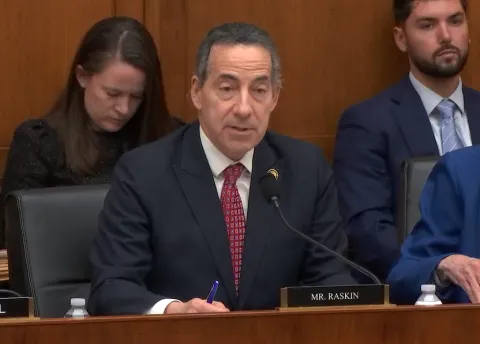
WATCH Ranking Member Raskin’s opening statement.
Ranking Member Jamie Raskin
Subcommittee on Courts, Intellectual Property, Artificial Intelligence, and the Internet
Hearing on “Oversight of the U.S. Patent and Trademark Office”
March 25, 2026
Thanks, Chairman Issa.
Thank you, Director Squires for joining us. As head of the U.S. Patent and Trademark Office, your job is to promote stability in the markets for goods and services by protecting trademarks used in interstate commerce. In pursuit of this mission, the USPTO has for decades been removed from partisan political intrigue and favoritism. By keeping politics out, prior Presidents and USPTO Directors ensured that applicants had a fair and honest system to rely on.
That seemed to change last year. You and President Trump injected partisan politics into the USPTO. From working to strip trademark examiners of any right to collective bargaining, a right which they’ve enjoyed for decades, and firing the members of the patent and trademark oversight bodies, to refusing to respond to Congressional requests for information, your tenure seems to be threatening the traditional integrity and nonpolitical nature of our system.
You recently took an extraordinary and unprecedented action. Earlier this year, the USPTO itself filed trademark applications on behalf of Donald Trump’s ill-defined private global pet project: The Board of Peace.
President Trump has declared himself Chairman for Life of this elusive entity. He’s promised billions of dollars in U.S. taxpayer dollars to the Board although Congress has not voted a dollar for it and he has secured billions of dollars more from mostly corrupt foreign governments, including Saudi Arabia, Kazakhstan, Azerbaijan, UAE, Morocco, Bahrain, Qatar, Uzbekistan, and Kuwait.
Beyond that, there’s much we don’t know about this shadowy venture: basic corporate structure, whether it’s a registered entity anywhere in the U.S., who controls the billions of dollars in its bank accounts, what country those accounts are located in, who will conduct audits and oversight of the Board, or what the President intends to do with this massive secret slush fund while he is in office—and after he leaves.
Yet when the Board of Peace decided it wanted to secure a trademark for its name and logo—a move that should have required it to identify the legal entity that actually runs it and controls its billions of dollars—you stepped in. You personally filed the trademark applications allowing USPTO to stand in as a straw trademark holder, to cover up for this international slush fund that appears to put both billions of US taxpayer funds and billions in payments from foreign governments into the pocket of Chairman for Life Donald Trump. The President set up a Board that likely violates both the Foreign and Domestic Emoluments clauses and you’re helping him run the operation.
What’s more, I’m not sure that either you or the Trump Administration realize what you’re confessing by filing a trademark application. You’re admitting that the Board of Peace is not a legitimate governmental body, but rather a commercial enterprise set up to enrich Donald Trump. Our trademark law began in 1879 when the Supreme Court struck down a trademark law that applied to any and all organizational designations. It ruled that Congress could only do so under the Commerce Clause.
So when Congress passed the Trade-Mark Act of 1881, it was written to apply only to marks used in commerce. The modern version of the Lanham Act in 1946 makes it clear that it only protects trademarks used in interstate commerce. Section 1052(b) of the Lanham Act specifically forbids the registration of any “insignia of the United States, or of any State or municipality, or of any foreign nation, or any simulation thereof.”
So, by filing for a trademark, you’re admitting that the Board of Peace is not really a governmental entity at all. It is a purveyor of influence, operating for profit with a billion-dollar admission fee, a commercial racket, a money-laundering scheme to pocket the billions he makes in this global shakedown in the name of peace
As far as I can tell, the USPTO has just 9 trademarks. Four are various logos for your office—some of which read USPTO others have the full name of the agency, IS Patent and Trade Office. Three more are for the phrases Go for Real and “You’re smart. Buy smart” phrases that were part of a public awareness campaign USPTO ran with the National Crime Prevention Council to raise awareness about the dangers of counterfeit goods.
The other two are now for the mysterious Board of Peace, which has no relation whatsoever to the USPTO.
By agreeing to act as Donald Trump’s “phone-a-friend” and using the USPTO to register a trademark on behalf of a third party, you’re violating a cardinal principle of the Lanham Act under 15 U.S.C. Section 1051, which explicitly lays out in subsection b that only “A person who has a bona fide intention, under circumstances showing the good faith of such person, to use a trademark in commerce may request registration of its trademark.” That is quite a problem for the agency whose role is to administer and police the registration of trademarks and to administer disputes.
One can only imagine there will be litigation, over the mark you claim to own, before your agency which is charged with being a neutral adjudicator of disputes. The only reason anyone ever registers a trademark is to prevent competing uses. Why would the Trump Administration tell you to file for this registration, except to suppress anyone else’s trademark related to “peace”?
But the field is crowded with existing registrations by other educational purveyors of global peace resources, to give a few examples I found online: World Peace Table, World Peace Network, Project Peace, Peace Vision Global, Universal Peace Plan, Global Peace Initiative, Global Peace Foundation, Universal Peace Federation, International Peace Center, the Peace House, Peace Network, Peace Action, Global Alliance for Peace, the Peace Trust, GreenPeace.
Any one of these organizations would have a strong case to sue for cancellation of Trump’s Board of Peace trademark, on the grounds that it dilutes and infringes their own pre-existing trademarks for “peace facilitation services,” and also, of course, that this mark is not registrable at all since it purports to identify a governmental entity. Not only would you have to decide whether Trump has a defense to prior users’ opposition to the marks, you would get to rule on any offensive use of trademark law by Trump. Let’s say he moves to attack the World Peace Table or GreenPeace for infringement of his commercial trademark, or opposes registration of any new organization that has the temerity to use “Peace” in its name? Who would adjudicate this? You would! You’re both the owner and the judge of any rights you have as an owner against anyone who wants to identify their organization with Peace.
This isn’t just a disreputable use of the trademark registration process. It’s the first step in giving Trump and his subordinates a monopoly in our country on use of the word “peace,” to make the very notion of peace unthinkable if it departs from the control of the Big Brother who now owns it. If President Trump can’t win a Nobel Peace Prize because he just plunged us into an aggressive war of choice, he’ll just own the word “peace” instead. So now war will be peace, as Orwell predicted, because he will own the word thanks to our newly corrupted trademark system.
I wrote to you last week, Director Squires, asking about this elusive entity and unprecedented situation. If there is a reasonable explanation for the USPTO’s conduct here, we need to hear it—because if you simply filed on behalf of the Board of Peace as a favor to the President, then we have a serious problem on our hands.
A decision like that doesn’t just drag the USPTO into covering up for a slush fund that may violate both the Domestic and Foreign Emoluments clauses —it’s bad for the integrity of our trademark laws. When people lose faith in the fairness and objectivity of the system, it begins to fall apart. So, I’m not just troubled that you’re violating the basic trademark rules. I’m troubled that, in violating the rules to help Donald Trump, you’re acting as a political operative in a way that will destroy our neutral system for regulating source-identifying trademark rights. The trademark system is designed to protect everyone. If applicants think the rules change for the wealthy and politically well-connected, they’re less likely to believe the system can work for them.
I look forward to finding out how you justify your agency registering a commercial mark for this alleged governmental entity, how you intend to resolve disputes with the dozens of past and future registrations of peace organizations and what you intend to do to restore the professional nonpartisan reputation of the USPTO.
Thank you, Mr. Chairman. I yield back.