
Ranking Member Raskin’s Opening Statement at Hearing on Republicans’ Effort to Prevent Injured Workers from Seeking Justice in Court
Washington, D.C. (January 14, 2026)—Today, Rep. Jamie Raskin, Ranking Member of the House Judiciary Committee, delivered opening remarks at the Subcommittee on Courts, Intellectual Property, Artificial Intelligence, and the Internet hearing examining Republicans’ shameful effort to shield stone slab manufacturers—including a top Trump mega-donor—from liability as workers get sick and die from silicosis.
Below are Ranking Member Raskin’s remarks at today’s hearing.
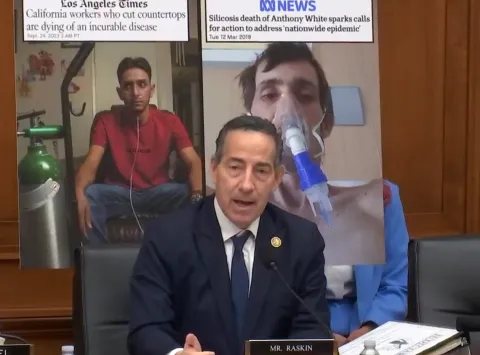
WATCH Ranking Member Raskin’s opening statement.
Ranking Member Jamie Raskin
Subcommittee on Courts, Intellectual Property, Artificial Intelligence, and the Internet
Hearing on “Between a Rock and a Hard Place: Protecting the U.S. Stone Slab Industry from Lawfare”
January 14, 2026
Thank you very much, Chairman Issa, and thank you to our witnesses for joining us today.
The House Judiciary Committee, of course, is not a jury. We’re not a courtroom. And when we do our work right, we’re facilitating the proper execution of the law and the protection of the rights of the people in courts across the land. That’s our proper role. I feel like we’re somehow being invited to be jurors today.
But in any event, I’m happy to learn about a very serious workplace related injury that’s taking place in the country. Acute silicosis is a disease that renders your lungs useless. You struggle to breathe as fluid fills your lungs up, cutting off your oxygen supply. There’s no cure for it. If you don’t get a $1 million double lung transplant, you effectively drown on dry land. Even the lucky people who get an organ transplant can extend their lives only by a few years. Silicosis is a killer. It’s contracted when workers who fabricate artificial stone inhale nanoparticles that settle in the lungs. They’re so small and so plentiful in artificial stone that they can escape any respirator and evade any protections designed for avoiding harms from silica in natural stone, like wet saws. Medical experts who treat silicosis patients agree that the only safe way to cut artificial stone is to wear a full hazard suit, or to have machine-only fabrication, neither of which is apparently yet technically or economically feasible.
Now, I confess, I knew nothing about any of this before this hearing was scheduled, but as I researched this horrid disease, I was pleasantly surprised to learn that her colleagues were suddenly focused on a severe health crisis afflicting working class craftsmen across America. I simply assume they were moved by the same headlines and articles I was reading, like one saying “SoCal man with silicosis wins lawsuit against makers of artificial stone slabs”; “Jury finds stone companies at fault in lawsuit by countertop cutter sick with silicosis; and “California workers who cut countertops are dying of an incurable disease.”
Alas, I’d fallen victim to magical thinking. Our colleagues were getting involved in this rather esoteric matter not to help the workers, but to help the industry they work in, and specifically the Trump megadonor, who is the only major domestic manufacturer of this artificial stone and is working like Houdini to escape liability for any and all of the injuries caused by the business that he’s involved in.
We are here for one reason and one reason only: because the jury system, and because American tort law, are actually working for the people who work in this field. Right now, the workers are getting extremely sick, and courts are finding that artificial stone manufacturers are at least partially at fault for it.
So what do my colleagues across the aisle propose to do? Do they want to ban artificial stone? That’s what they did in Australia as an inherently dangerous substance. No. Do they think we should prosecute the artificial stone CEOs for deliberate or negligent failure to warn workers, as Spain did in 2023? No. Do they want to let our American court system do what it does best and hear claims on a case-by-case basis, under the general principles of American tort law and products liability? No. They want, as I understand it here—and I would love to be corrected—they want to immunize the big, primarily foreign owned manufacturers from being held accountable for the results of this process in our court system.
You know, I’ll close with this thought, Mr. Chairman. There was a brief, fleeting moment when our colleagues across the aisle struck the pose of being the party of the working man. I remember it well. Donald Trump promised in 2016, “Five, 10 years from now – different party. You’re going to have a worker’s party.” On the campaign trail in 2024, now-Vice President J.D. Vance told a crowd, “We need a leader who’s not in the pocket of big business, but answers to the working man — union and non-union alike.” And just two months ago, Vance said in an interview with Breitbart News, “We’ve got a lot of working-class voters who, frankly, don’t care what was Republican orthodoxy 25 years ago, and so they’re pushing the party in a different direction.”
Well, my friends, if anybody wants to hang on to the fading embers of the idea that the GOP is the party of the working class, this hearing should put an end to that fantasy. Immunizing employer corporations who repeatedly, knowingly subject workers to the kinds of hazards involved in this process and then want to escape all liability is not an agenda that would be embraced by the party of the working class.
Thank you, Mr. Chairman, I yield back.