
Ranking Member Raskin’s Opening Statement at Hearing on How Republican Corruption and Extremism Broke the Supreme Court
Washington, D.C. (May 21, 2026)—Today, Rep. Jamie Raskin, Ranking Member of the House Judiciary Committee, delivered opening remarks at a Subcommittee on Courts, Intellectual Property, Artificial Intelligence, and the Internet hearing condemning the decades of right-wing politicization, corruption and dark money that have led Americans to lose trust in the Supreme Court.
Below are Ranking Member Raskin’s remarks at today’s hearing.
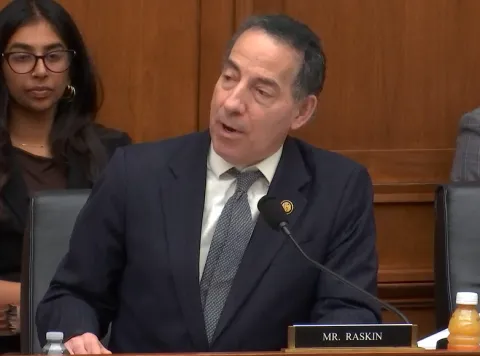
WATCH Ranking Member Jamie Raskin
Subcommittee on Courts, Intellectual Property, Artificial Intelligence, and the Internet
Hearing on “Court Packing: A Threat to the Supreme Court’s Legitimacy”
May 21, 2026
Thank you very much, Mr. Chairman.
I suppose the court packing, like justice itself, lies in the eye of the beholder. But there are many different kinds of court packing. Here’s one. When Justice Scalia died in February of 2016, when Barack Obama was president, Senator Mitch McConnell announced ten and a half months before the presidential election that the Senate would not be considering any replacement. The Judiciary Committee would not have any hearing. There’d be no vote in committee, and there’d be no vote on the floor.
When people asked why—it makes no sense to hold the Supreme Court seat open, to hold that vacancy open for nearly a year—he said it was “too close” to the next presidential election, and the people should decide. Of course, the people had decided in electing Barack Obama to one of those genuine, bona fide four-year terms in office, like every other president. Well, we’ve got a controlled experiment about what would happen, because that was held open. Merrick Garland was nominated by Barack Obama and was left twisting in the wind for nearly 11 months after the death of Justice Scalia. Then, Trump, when he got in, was able to nominate Neil Gorsuch to the seat in his first week in office. That seat was open for 422 days.
And Mitch McConnell bragged about it, calling it the most consequential decision of his entire public career. Of course, it cemented the rapid movement of the Supreme Court to the right to incarnate the MAGA agenda on the Supreme Court.
Well, look, here’s what happened when Ruth Bader Ginsburg died. Now, she died on September 18th, 2020, so close to the next election, which was less than two months away, that early voting had started in a lot of the states. So, it wasn’t even two months away. And then the Democrats asked Mitch McConnell—some reporters asked Mitch McConnell—of course, you’re not going to have hearings or vote or anything in the next few weeks, are you? And he laughed it off. He laughed off the suggestion that they would maintain the same rule that they had used to block Merrick Garland and President Obama from having a seat. And then they rammed through the nomination of Amy Coney Barrett within two months, consolidating the right wing, anti-choice, anti-environmental regulation, anti-labor, anti-voting rights, anti-democracy majority on the Supreme Court.
Had the original McConnell rule been applied, or even a reasonable approach taken with just a few weeks before the election, that’s that Supreme Court seat would have been filled by President Biden, not by Donald Trump. Biden won that election, by the way, by more than 7 million votes. If you’re interested in what the people want, 306-232 in the Electoral College—I know some people came down to overthrow the election, attack our police officers in order to accomplish a political coup, to deny that—but that’s what happened.
So right there, we’ve got two seats officially stolen by Mitch McConnell and the Republican Senate, giving them a 6-3 MAGA court with a majority of the court now made up of nominees of presidents who lost the popular vote. Roberts and Alito, Gorsuch, Kavanaugh and Amy Coney Barrett, all nominated to the Court by presidents who lost the popular vote.
Now, if you don’t believe that this Supreme Court has conceived and achieved a remarkable transformation in constitutional jurisprudence, ethics, and behavior on everything from abortion to voting rights to political corruption cases, then you don’t have to believe me, or you don’t have to believe your own eyes. Just listen to Donald Trump, who openly says it’s really okay for them to be loyal to the person that appointed them to almost the highest position in the land, a justice of the U.S. Supreme Court, he berates and vilifies justices and judges up and down the federal system who disagree with him or who he feels have been insufficiently robotic in their loyalty to the MAGA agenda.
It’s true, he doesn’t want a justice loyal to the people, as the good Chairman of the Subcommittee says, or the constitution, he wants a Supreme Court loyal to him, and whatever is going to advance his interests, his money, his family, his corporations. He’s got a Supreme Court majority so robotically loyal that they will pluck a doctrine out of thin air. Nothing to do with originalism, nothing to do with textualism—out of thin air, to insulate the President from liability for felony crimes committed in office. We went for more than two centuries without any president ever claiming the right to commit crimes under his office and not to be prosecuted for it. But here we are today.
The Supreme Court, we must acknowledge, has been a profoundly conservative, reactionary institution for the vast majority of our history. And what did the Supreme Court ever do for enslaved people between the founding and the Civil War? Nothing other than in 1857 and the Dred Scott decision cement their subjugation into place, saying that the African slave and his descendants have no rights a white man is bound to respect in any way. And then, even after the Civil War, after the passage of the 13th, 14th and 15th Amendments drawn from the blood, sweat and tears of the union and the people who fought to defend our country against the confederacy, the Supreme Court gutted the meaning of the reconstruction amendments in the civil rights cases, and then in 1896, Plessy v. Ferguson constitutionalized the reign of Jim Crow, separate but equal.
So we have a couple decades around the Warren Court, maybe the first few years of the Berger Court, where the Supreme Court acted on the side of the people. Brown v. Board of Education, striking down American apartheid, the white primary line of cases, Terry v. Ohio, Roe v. Wade. But it didn’t last long before it all sank away with the Rehnquist Court and the Roberts Court. And now they’ve returned to the historic baseline of political white supremacy. They wiped out our Voting Rights Act, first in Shelby County v. Holder in 2013, and a couple months ago in the Callais decision. And we are about to see, they’re not going to be able to accomplish it all in 2026, but by 2028, we will probably see all white congressional delegations from the deep south, wherever the Republicans control the state legislatures.
Okay, that is court packing. That’s political packing by a packed Supreme Court. The court today has a legitimacy crisis, not just because of the way it’s been composed and stacked and packed and gerrymandered and divided by Mitch McConnell, who laughs about it. He thinks it’s funny what they did.
Why do some people want 13 members of the Court, Mr. Chairman? You don’t need a conspiracy theory for that. There are 13 federal circuits in America, and traditionally, the Supreme Court has been made up of the number of justices equal to the number of circuits. And we got 13 circuits, but we only have nine justices. So that means that under the best of circumstances, for entire federal regions, four federal circuits will be left out completely. And it’s much worse than that today because we’ve got five justices from New York City alone, one for each borough. But you’re telling a majority of the people who live in a majority of the states that they can’t find anybody qualified to serve on the Supreme Court. So that’s the answer to that particular question.
But we’ve got a complete structural, ethical jurisprudential crisis in the Supreme Court whose name is in the gutter because of these terrible decisions that they keep issuing, like the overthrow of Roe v. Wade, Planned Parenthood v. Casey, the complete construction out of thin air of immunity of precedence to commit felony crimes while in office, and so on. And I hope that this court will do its best to try to behave like a Supreme Court, but there are things that we can do. And I introduced one bill yesterday called the SCCOTUS Act, and the SCCOTUS Act is creating a new way for cert to be granted because this Supreme Court is obviously acting like a legislature. I mean, they set up an agenda where they want this case about the Voting Rights Act. They want to destroy it. Oh, now it’s time for us to overthrow abortion rights. We’re going to take that case. All right.
A lot of countries don’t leave the agenda-setting authority to the court itself. And certainly, we should not leave it in the hands of this Supreme Court. It belongs with the 13 federal circuits. We should have a panel made up of the chief judge of each federal circuit or their designee, if they want another judge to do it, and they should decide when there is a meaningful circuit split or a federal question that should go up to the Supreme Court. This court obviously cannot be trusted with that agenda setting authority. Let’s begin to create a real Supreme Court in the country by moving in this direction.
And I thank you, Mr. Chairman. I yield back to you.
###