
Ranking Member Raskin’s Opening Statement at Hearing on FISA Reforms to Protect Americans’ Civil Liberties
Washington, D.C. (December 11, 2025)—Today, Rep. Jamie Raskin, Ranking Member of the House Judiciary Committee, delivered opening remarks at a full committee hearing on oversight of the Foreign Intelligence Surveillance Act (FISA) and how President Donald Trump has removed key guardrails protecting Americans’ privacy and civil liberties.
Below are Ranking Member Raskin’s remarks, as prepared for delivery, at today’s hearing.
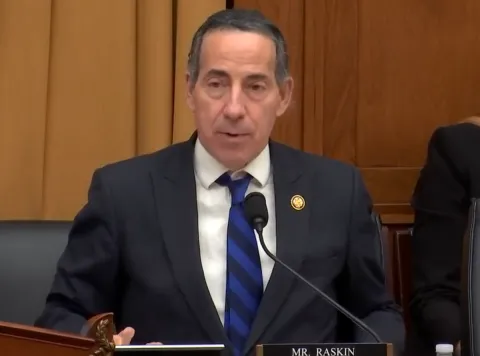
WATCH Ranking Member Raskin’s opening statement.
Ranking Member Jamie Raskin
House Judiciary Committee
Hearing on “Oversight of the Foreign Intelligence Surveillance Act”
December 11, 2025
Thank you, Chairman Jordan, and thank you to the witnesses for being with us here today.
Section 702 of the Foreign Intelligence Surveillance Act expires on April 19th of next year. That gives us just four months to put together a bill that prioritizes Americans’ constitutional rights while preserving a program that is vital to national security.
Over the years, FISA has remained a subject of bipartisan collaboration on this Committee, and I thank Chairman Jordan and Chairman Biggs for working with me to protect Americans’ civil liberties.
When Congress reauthorized Section 702 last Congress, we gave the executive branch two years to show that it could protect Americans’ civil liberties without the need for greater judicial oversight. We said that we would rely on the FBI’s promise: that the modest changes, like requiring approvals for U.S. person queries, in the Reforming Intelligence and Securing America Act, or RISAA, would be enough to prevent further violations of Americans’ civil liberties. And we promised in turn that we would keep a close eye on how surveillance authorities are used during that time.
This two-year experiment is nearly complete and the results are alarming. Under the Second Trump Administration we have witnessed an assault on the FBI’s internal guardrails against abuse of Section 702 authorities, an unprecedented increase in government surveillance, and an alarming coziness between the government and Big Tech—all of which puts Americans’ data and civil liberties in jeopardy. We must strengthen federal law to protect Americans’ privacy and Congress can start with FISA Section 702.
As everyone in this room knows, FISA Section 702 was never meant to apply to American citizens. Under the law, the government can only collect communications from targets who meet two criteria: (1) they must be non-U.S. persons; and (2), they must be located overseas. Americans and people on U.S. soil are protected by the Fourth Amendment that prohibits unreasonable searches, including government programs that simply vacuum up Americans’ communications in the name of national security. If law enforcement wants to look at American citizens’ emails, they must get a warrant as the Constitution requires.
Despite these protections, because Section 702 enables the intelligence community to ingest an incredible amount of data, Americans’ communications are often swept up in 702 collection. Once that happens, those records end up in the FBI’s massive database—and, under current law, the FBI can search that database for U.S. person identifiers, like Americans’ names or street addresses, for evidence of a crime or threats to national security.
Administrations of both parties have repeatedly abused this trove of U.S. person data. Recent audits show that FBI has searched the 702 database for candidates for federal office, Black Lives Matter protesters, and federal contractors, among other Americans who ought to be better protected.
Two years since we enacted RISAA, however you might have felt about the modest changes in that bill, the landscape has changed. For years, the leaders of this Committee have warned of how executive branch surveillance powers could be abused by a president who didn’t care about protecting civil liberties, who used cutting-edge technology to spy on Americans, and who ignored basic principles of due process and constitutional freedom to achieve their own ends. In 2025, we no longer have to wonder if we were right to worry.
Here’s just one example: I have been concerned for years about the U.S. government purchasing and compiling data about its own citizens. That problem has been compounded by the Trump Administration, which is actively building profiles on American citizens. By combining data traditionally siloed in separate agencies—your tax returns, your health records, any interactions with police—with information purchased from tech companies, the Trump Administration is breaking down the few guardrails that still remained on our privacy, enabling the executive branch to track the movements of dissenters and supporters alike.
I’m glad we’re proceeding in a bipartisan way for the legislative defense of essential constitutional civil liberties. I look forward to hearing from all of our witnesses today and how we can properly protect American civil freedom in this perilous era.
I yield back to you, Mr. Chairman.