
Ranking Member Raskin’s Opening Statement at Hearing on Airline Consolidation and Trump’s Iran War Driving Higher Prices for Americans
Washington, D.C. (June 24, 2026)—Today, Rep. Jamie Raskin, Ranking Member of the House Judiciary Committee, delivered opening remarks at a subcommittee hearing examining how decades of airline consolidation, weakened antitrust enforcement, and rising fuel costs tied to the Trump Administration’s Iran war are driving up prices and limiting choices for Americans. Below are Ranking Member Raskin’s remarks, as prepared for delivery, at today’s hearing.
Image
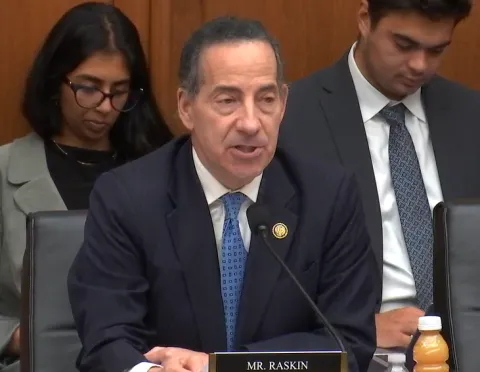
WATCH Ranking Member Raskin’s opening statement. Ranking Member Jamie Raskin Subcommittee on the Administrative State, Regulatory Reform, and Antitrust “The 30,000 Foot View: Competition and Regulation in the U.S Airline Industry” June 24, 2026 Thank you, Chairman Fitzgerald, and thanks to the witnesses for being with us here today. Spirit Airlines was once the nation's leading ultra-low-cost carrier and one of the strongest forces in the economy, holding down ticket prices for consumers. It's now collapsed, and we can’t have a serious conversation about the demise of Spirit Airlines without talking about the main culprit: the President’s disastrous and illegal War with Iran. The Iran War has not only cost the lives of 13 American service members and thousands of Iranian civilians, including hundreds of children. It has cost American taxpayers more than $100 billion and American consumers more than $60 billion in increased fuel costs—which averages to more than $470 per household. It also caused the cost of jet fuel to double overnight, forcing Spirit to take on $100 million in unexpected costs in just a few months. For an ultra-low-cost carrier like Spirit, which operates on paper thin margins to deliver the best value to consumers, that was a death sentence. As Spirit Airlines itself explained in its legal filings, the company went under because “Recent geopolitical events have resulted in a massive and sustained increase in fuel prices.” Desperate to avoid voicing any criticism of Trump’s disastrous and misconceived war, my Republican colleagues have decided to blame overzealous antitrust enforcement. Americans are paying more today for groceries, gasoline, healthcare, housing, utilities, and airfare. At the same time, a vanishingly small number of companies are thriving. Consider the S&P 500, a stock market index of 500 publicly-traded US companies. Last month, the FINANCIAL TIMES published an analysis that just five of those 500 companies—1 percent—accounted for 50% of the index’s growth. In the airline industry, the story of lopsided growth and economic concentration is the same. In 2000, the four largest carriers controlled roughly 60 percent of domestic traffic. Today they control about 80 percent. One merger after another has consolidated the market power of the four major airlines: American, Delta, Southwest, and United. The result: higher prices, lower wages, and growing profits. Protecting competition requires regulators willing to say no to corporate consolidations. In 2023, the Department of Justice blocked JetBlue’s attempted acquisition of Spirit Airlines. The result: Spirit Airlines continued to operate as an ultra-low-cost airline offering consumers lower prices than competitor airlines and driving down the price of tickets on competitor airlines. Economists called this “the Spirit effect”: when an ultra-low-cost airline like Spirit operates a route, the price of tickets on legacy carriers, like American, drop by an average of 21%. As Judge Young, the Reagan appointed judge who upheld the DOJ’s decision to block the Spirit-Jet Blue merger explained: “[I]f JetBlue were permitted to gobble up Spirit—at least as proposed—it would eliminate one of the airline industry’s few primary competitors that provides unique innovation and price discipline. It would further consolidate an oligopoly by immediately doubling JetBlue’s stakeholder size in the industry. Worse yet, the merger would likely incentivize JetBlue further to abandon its roots as a maverick, low-cost carrier.” DOJ’s actions in 2023 protected consumers from increased costs by forcing airlines to continue competing with Spirit and its ultra-low airfares—until skyrocketing gas prices caused by Trump’s War in Iran caused the airline to collapse. Yet, my Republican colleagues seem intent on learning the wrong lesson from this story, claiming we need less antitrust enforcement, rather than more. This is alarming because under the Trump Administration, antitrust enforcement has been twisted and corrupted beyond recognition. Instead of being a tool to protect competition and innovation and to prevent companies from abusing their market power over consumers and workers, it has become just one more grift perpetrated by the President and his enablers for their own purposes of wealth maximization. Antitrust practitioners speak openly about a “Trump transaction tax”—the idea that merger approval depends less on competition concerns and more on a company’s willingness to curry political and financial favor with the President. The warning signs of gangster-state crony capitalism are everywhere In the last twelve months, this Administration has cleared the Nexstar-Tegna local broadcast merger which will undermine the diversity of independently-owned news operations and which a coalition of state attorneys general has already obtained a preliminary injunction to halt. It has settled the Live Nation-Ticketmaster case with terms so favorable to Live Nation that the basic sweeping harms to artists, venues, and millions of fans remain largely unaddressed. It cleared the Paramount-Skydance-Warner Bros. Discovery deal before career investigators had even finished their antitrust analysis. And every senior antitrust official who has raised concerns about this pattern of concentration and consolidation — including Assistant Attorney General Gail Slater at DOJ and her Principal Deputy Attorney General Roger Alford — has been pushed out or fired for the offense of simply doing the job they signed up to do and which the law requires of them. The consequences of this anti-antitrust corruption and pro-monopoly favoritism are simple: Corporations pass the Trump Tax onto consumers. We pay higher prices for fewer choices. Less competition. Less innovation. More instability. Instead of helping concoct a cover story for the President—which blames Biden for the disastrous consequences of the trump tariff and the Trump war in Iran—we should be doing serious oversight of an antitrust enforcement system that has been thoroughly smashed up in this administration. Thank you, Mr. Chairman. I yield back.
|