
At Republican Rerun Hearing on Sharia Law, Ranking Member Scanlon Slams GOP’s Unconstitutional Attack on Religious Liberty
Washington, D.C. (May 13, 2026)— Today, Rep. Mary Gay Scanlon, Ranking Member of the Subcommittee on the Constitution and Limited Government, delivered opening remarks at a subcommittee hearing on Republicans’ campaign to restrict religious freedom, reprising a Sharia law hearing the majority already held in February.
Below are Ranking Member Scanlon’s remarks, as prepared for delivery, at today’s hearing.
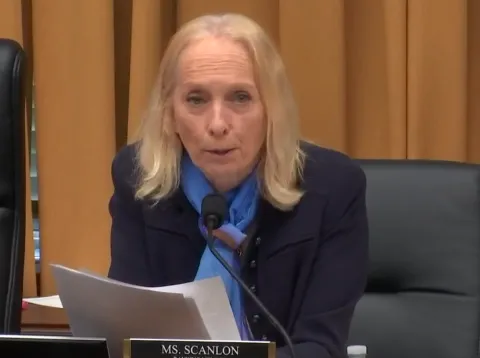
WATCH Ranking Member Scanlon’s opening statement.
Ranking Member Mary Gay Scanlon
Subcommittee on the Constitution and Limited Government
Hearing on “Sharia-Free America: Why Political Islam & Sharia Law Are Incompatible with the U.S. Constitution II”
May 13, 2026
This is the second time this year that this subcommittee has been convened to hold a hearing about Sharia law, which, unsurprisingly, doesn’t even rank on the list of issues keeping Americans up at night.
Actually, it doesn’t appear to be an issue anywhere in this country, except Texas, where Republican politicians are so desperate to distract voters from the disastrous economy and surging gas prices, because, as one Republican strategist said, these candidates don’t want “to be talking about the economy right now.” They’ve made up a conspiracy theory about their Muslim neighbors in order to scare voters.
But repeating lies over and over doesn’t make them true. And it doesn’t make unconstitutional bigotry legal.
Last time the subcommittee convened on this topic, I wondered if our colleagues actually believed their own hysterical and wildly unsubstantiated claims about people of the Muslim faith trying to impose so-called “Sharia law” on the United States. But, as before, they’ve not produced one ounce of proof to vindicate their fearmongering. Tellingly, they’ve also not produced a single Muslim witness or expert on Islam or Sharia law.
And the only thing that’s changed between the last hearing and now is that Texas’s fiercely contested Republican primaries have moved into runoff elections, now just under two weeks away. So, in Texas, this issue continues to be a flashpoint for Republican federal, state, and local candidates as they desperately compete with one another over who can be “toughest” against their Sharia law fantasy—a threat based not in reality, but invented by scare tactics and manufactured alarm.
Because, like belief systems that guide adherents of other faiths, including Christianity or Judaism, Sharia is about individual, personal, religious observance—not about shaping our national laws.
And contrary to the misleading claims offered here, there’s no evidence of any plot to impose Sharia law on non-believers of Islam. It’s just not happening.
No matter how many right-wing influencers make videos about it, Texas laws are passed to combat it, or legislation named by a flashy acronym is introduced here in D.C., decrying it, there’s still no evidence that a proposed real estate development in the Dallas suburbs, initiated by members of the area’s growing Muslim population, is a “sharia compound,” as Texas Republicans have alleged. To say otherwise is to spread blatant misinformation.
In fact, even the Trump Justice Department closed an investigation into the development, finding no basis for any violation of fair housing laws.
Politicians standing against made-up threats of Sharia law are shamefully scapegoating Muslim Americans for political gain, without any care for how many people may end up as collateral damage to this kind of rhetoric. Because these culture wars, including cheap political stunts like scapegoating followers of Islam, have real-world consequences.
Words matter, and by stirring up hatred and bigotry, real people have been put at risk. Hate crimes against Muslims in particular have increased. In cynically playing on division to win an election, Republicans are sacrificing the safety of the very Americans they’re trying to represent.
The fact is, here in this country, you can’t ban a person’s right to practice Islam any more than you could ban a person’s practice of Christianity, Judaism, or their decision to practice no religion at all.
Our Constitution, and particularly the First Amendment, which was central to its adoption in 1787, remains clear: in this country, people have the right to hold and express whatever religious beliefs they choose—or none at all.
And, despite the arguments we’ve heard today from our Republican colleagues, we know that from our Republic’s earliest days, Muslims were intended to be included within the fabric of American life. Thomas Jefferson specifically referenced followers of Islam, among other faiths, in his writings about the passage of the Virginia Statute for Religious Freedom in 1786—one of his proudest achievements, and the First Amendment’s precursor.
This is a core component of our Constitution that’s particularly valued in my home state of Pennsylvania, which was founded by William Penn to promote religious diversity, and where the Constitution was written!
For hundreds of years, Pennsylvania has been home to people of many faiths and denominations, including Protestants, Catholics, Jews, evangelicals, Quakers, Muslims, and people with no faith at all. In my district, we have a growing cultural center, Africatown, founded by immigrants turned citizens, many of whom are Muslim and have made huge contributions to our economic, cultural, charitable, and civic life.
One of our most cherished American values is that you don’t have to agree with your neighbor’s beliefs. But no one can use the power of the government to punish or discriminate against those who do.
And since this is the Constitution Subcommittee, any of my colleagues who find that principle suspicious or foreign should probably take another look at our First Amendment and the oath they took to support and defend the Constitution.
Unfortunately, over and over again, we’ve seen this White House and its Republican allies in Congress try to use the power of the federal government to spy on and target Americans whose opinions and beliefs they don’t like, whether they be religious, political, or otherwise.
But Americans know that if the government can go after one group, it can just as easily go after us all. That’s why people have shown up, stood up, and spoken out against this kind of sentiment.
Instead of trying to score political points at the expense of innocent people, I wish our Republican colleagues would focus on making Americans’ lives better instead of going along with this administration’s tariff wars, which have driven up the price of housing, cars, and consumer goods, slashing of programs that Americans rely upon for better health care, housing, energy, and nutrition, foreign wars that have put Americans in danger, and attacks on basic liberties, like free speech, a free press, and the right to peaceful protest.
We should be uniting behind the fundamental principles that make this country great, not fueling division by going after our fellow Americans—our family, our friends, our neighbors—casting them as the enemy.
I yield back.
##