
At Republican Rerun Hearing on Sharia Law, Ranking Member Raskin Slams GOP’s Unconstitutional Attack on Religious Liberty
Washington, D.C. (May 13, 2026)—Today, Rep. Jamie Raskin, Ranking Member of the House Judiciary Committee, delivered opening remarks at the Subcommittee on the Constitution and Limited Government hearing on Republicans’ campaign to restrict religious freedom, reprising a Sharia law hearing the majority already held in February.
Below are Ranking Member Raskin’s remarks at today’s hearing
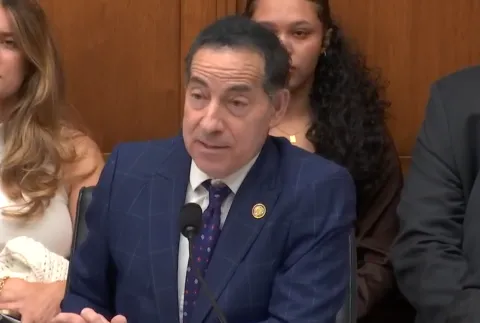
WATCH Ranking Member Raskin’s opening statement.
Ranking Member Jamie Raskin
Subcommittee on the Constitution and Limited Government
Hearing on “Sharia-Free America: Why Political Islam & Sharia Law Are Incompatible with the U.S. Constitution II”
May 13, 2026
Mr. Chairman, thank you. And thanks to our witnesses.
Forgive me, but didn’t we have this exact same hearing not that long ago? I think it’s the fourth or fifth in the line. I can’t believe that the cupboard of Republican ideas is so barren now that in order to distract America from Donald Trump’s illegal, unconstitutional, ruinous war and his ruinous, illegal, unconstitutional tariffs and the spiraling price of gasoline and the unlivable economy he’s created, that we have to go back and have this exact same hearing over and over again. Couldn’t we come up with something else instead? It’s not exactly working to reverse Donald Trump’s precipitous slide into being the most unpopular president in American history, because that’s where we are.
So, if we’re going to have another religious convocation, perhaps next time, it could be a debate between Donald Trump dressed up, perhaps like Jesus Christ and the Pope of the catholic church, so the Pope can answer Trump’s recent accusation that he’s weak on crime. I never got that charge. After all, Trump himself is a convicted felon who’s pardoned more than 1,600 rioters, insurrectionists, Proud Boys, Oath Keepers, domestic abusers, child molesters, white-collar fraudsters and international narcotraffickers and drug dealers. And the Pope is certainly not weak on him. The Pope has made his views on Donald Trump perfectly clear. So I don’t understand why Trump is saying that the Pope is weak on crime.
Anyway, I had this idea I wanted to float by my colleagues to perhaps create some legislative progress in this field. The Republicans are afraid that Muslims are going to impose Sharia law on the rest of the population. Now, I’m not so afraid of that, because we have 535 Members of Congress, and only four of them are Muslim, which makes it extremely unlikely. How could less than 1% of Congress impose Sharia law on the other 99%? And what’s even more reassuring is I actually know some of these Muslim Americans who happen to be in Congress, and they’re all civil libertarians who stand up for the separation of church and state. But even if they changed their minds and convinced all the Christians, Jews, Hindus, and Freethinkers in Congress who are 99% of the House to vote for Sharia law, I’m sure someone on the Senate side, where there are no Muslims at all, would put a hold on it, like everything else that we send over there. So, I’m a pretty good vote counter, and I don’t think that there would be a single vote to establish Sharia law in the United States Congress or in any state of the union.
But anyway, I had this idea to take advantage of the fact that we all agree on this point. Why don’t we generalize the proposition of this anti-Sharia law movement to say that the government should not be endorsing or establishing any religion in America, whether it’s Islam, Christianity, Judaism, Jews for Jesus, Seventh Day Adventism, Jehovah’s Witnesses, Mormonism, Unitarian-Universalism, Branch Davidianism or Hare Krishna? I was playing with some language and I came up with this rough cut, Mr. Chairman, it goes like this: “Congress shall make no law respecting an establishment of religion, or prohibiting the free exercise thereof. . .”.
What do you think about that? Do you think that covers it? We could call the first part the Establishment Clause. We could call the second part the Free Exercise Clause. I know we could get that through the Democratic caucus. Do you think we could get it through the Republican conference? I’m not sure, I hope so.
The problem is that we’ve got theocrats out there across the religious spectrum who want to elevate their own religious creeds and dogmas above the Constitution and establish them over the secular law. Take, for example, what the Texas and Louisiana legislatures recently did. They voted to endorse the Ten Commandments and post the Ten Commandments in every public school classroom in their states. I didn’t even know that was necessary because I thought the Ten Commandments were doing all right. I didn’t know they needed an endorsement from the Republican conference, but they went ahead and did that. Now they want to vote in every state legislature to endorse the Ten Commandments and to post the Ten Commandments. I’m opposed to that because of the provision in the Constitution, Article VI, Clause III, which says there shall be no religious test for public office. That sounds like a religious test, when you round up all the politicians and you ask them to vote on the Ten Commandments.
And by the way, if we are going to vote on the Ten Commandments, Mr. Chairman, I do not support that omnibus Republican package. I think we should have to vote on each commandment separately, and I don’t think that you should be able to vote for any commandment you yourself have ever violated, because then we’ll be taking the name of the Lord in vain.
You know, one politician I spoke to on the floor about this, he said that the Ten Commandments are the basis for the Bill of Rights. He kind of confused me there for a second. I said, well, I do know that there are ten in each one. That’s true. But let’s test the proposition. The First Commandment says: “Thou shalt have no other gods before me.” The First Amendment says: “Congress shall make no law respecting an establishment of religion.” It’s hard to see how the First Commandment dictates the First Amendment.
So, “Is Sharia Law Incompatible with the Constitution?” is the title of the hearing. Sure. And so is legislating any other religious text: the Ten Commandments, the Torah, or the Analects of Confucius, or whatever, any religious scripture or body. The whole point of our First Amendment is that people can go believe whatever they want. The government’s not going to dictate to you what your religious worship and practice are going to be. The government is out of it. I did not write that language, to be clear. James Madison wrote that language. He took care of your whole “anti-Sharia law” law centuries ago. This is a complete waste of time. And he had the right idea. Madison would be appalled that the Fifth Circuit Court of Appeals just voted 9-8 to uphold the compulsory Ten Commandments display in every school classroom in Texas or Louisiana.
Louisiana can do that. It can compel display of the Five Pillars of Islam. Think about that. You really want to head down that road. The states could force display of the Ten Precepts of Buddhism, the Analects of Confucious, or the Five Principles of Hinduism, if you can put up the Ten Commandments. And by the way, the Ten Commandments doesn’t exist as one commonly agreed upon body of law. If you go online, you’ll find like 10 or 15 different versions of the Ten Commandments. There’s a Catholic version, there’s a Lutheran version, there’s a Jewish version, a Baptist version, Mennonite, and so on. You know, if you can compel display of ten of them, you can compel display of all of them. There could be 100 commandments. There could be 150 commandments.
So look, my friends, we don’t need an “anti-Sharia law” law or an “anti-Christian law” law or an “anti-Jewish law” law or an “anti-Hindu law” law. We’ve already got one forbidding the imposition of any religious orthodoxy, forbidding the endorsement of any religious orthodoxy. It’s called the First Amendment, and everybody should familiarize themselves with it, because this is a complete waste of time, what we’re doing here. The government cannot establish, prefer, legislate, coerce, impose or endorse any religious doctrine.
We don’t need a special law or a special caucus to do that. And if my friends understand that, then I think they will reverse course on this movement unless the purpose of the movement is just to demonize and vilify, not a religion, but adherents of the religion. But then I would have to believe that my colleagues are actually out just attacking Muslims, attacking Muslim Americans, criticizing and vilifying them for their beliefs or their way of life. And I don’t want to believe that.
But I do challenge my friends to state one thing that an “anti-Sharia law” law would do that the First Amendment doesn’t already do. Tell me one thing that we would need to legislate that’s not already taken care of by the Establishment Clause or the Free Exercise Clause.
The real threat to our Constitution comes not from adherents of a particular religion, but from turning our backs on the Constitution and the First Amendment. Our freedoms are not under siege by a religious minority trying to build a community center, but they are undermined by lawmakers who would want to turn Americans against each other on a religious basis.
And is it true that religious fanatics commit violent criminal acts? Absolutely. I mean, you talk to any secular freethinker, and they will say that every religion has produced religious fanatics who have committed violence. Take, for example, Timothy McVeigh, who was part of the Christian identity church—the Christian identity movement trained on racism and antisemitism. He blew up the Oklahoma Federal Building in 1995, 167 people killed, 684 wounded. They blew up a nursery school. He was a violent, fundamentalist Christian fanatic. But you wouldn’t blame all Christians for what he did any more than you should blame all Muslims, or all Jews, or all members of any religious faith because of what one person or one crazed fanatic group does in their name.
So, Mr. Chairman, I trust you understand all of that, I do hope we will return to constitutional principles. I yield back.